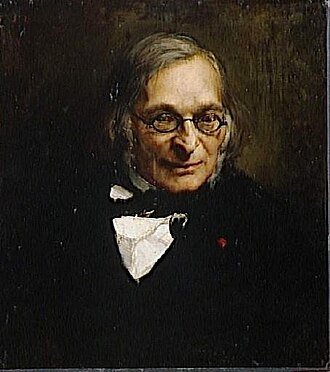
Adolphe Franck
1810–1893 · French philosopher of eclectic tradition and scholar of Judaism
Adolphe Franck (Liocourt, 1810 – Paris, 1893) was a French philosopher of spiritualist and eclectic leanings, in the line of Victor Cousin, and one of the leading nineteenth-century scholars of Judaism and Jewish mysticism. He first trained to become a rabbi but turned to philosophy instead, and in 1832 he placed first in the agrégation in philosophy, which opened the way to a teaching career in several lycées and later at the Collège de France.
In 1844 he published The Kabbalah, or the Religious Philosophy of the Hebrews, a work that earned him a place in the Academy of Moral and Political Sciences while still in his thirties. That same year the Dictionary of Philosophical Sciences began to appear under his direction, with dozens of contributors. From 1854 to 1881 he taught a course on natural law and the law of nations at the Collège de France.
His most original contribution lies in the philosophy of criminal law. Against the view that punishment is expiation and that society has a right to inflict suffering, he argued for society's right to preserve itself, from which he derived a right of deterrence and a right of reparation. His influence was felt above all in the study of Kabbalah and in French legal debate.
Key ideas
- Spiritualist eclecticism: philosophy should reconcile the great forms of human thought, which he distinguished as naturalism, idealism, scepticism and mysticism.
- Reason and conscience as authority: despite his ties to Jewish tradition, he recognised only reason and conscience as final authorities.
- Kabbalah as philosophy: he read the Kabbalah as a genuine religious philosophy whose roots predate its earliest written sources.
- Society's right of preservation: punishment should rest not on expiation but on society's right to defend itself against anyone who seeks to destroy it.
Original Filopedia text based on Wikipedia (es) and Wikipedia (en) and Wikidata.