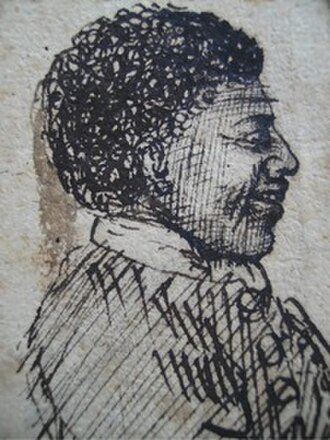
Anton Wilhelm Amo
1700–1759 · Ghanaian-born philosopher and professor in early eighteenth-century Germany
Anton Wilhelm Amo (c. 1703 – c. 1759) was a philosopher and university teacher born on the Dutch Gold Coast, in what is now Ghana, who worked in Germany during the early Enlightenment. He matters for two reasons: he was one of the first Africans to earn a doctorate in philosophy in Europe and to teach at a European university, and his Latin writings take part in the debate on mind and body within the empiricist tradition.
Amo was a Nzema, from the Axim area. At about the age of four he was taken to Amsterdam; whether he was enslaved or sent there by a preacher is unclear, and sources disagree. From there he was given to the court of the Duke of Brunswick-Wolfenbüttel, where he was treated as a member of the ducal household. He was baptised in the palace chapel and schooled at the local academy and at Helmstedt. He then studied law at Halle, where he wrote a dissertation on the rights of Black people in Europe, and went on to Wittenberg, where he took up subjects from logic to medicine and mastered six languages. His medical training would shape much of his later thought. In 1734 he earned his doctorate at Wittenberg with a thesis that, within a broadly Cartesian framework, argued that sensation belongs to the body rather than the mind.
He returned to lecturing at Halle in 1736 and in 1738 published his best-known work, a treatise on philosophising soberly and accurately. Close to Locke and Hume, it argued for an empiricist epistemology and criticised intellectual dishonesty, dogmatism and prejudice. In 1740 he took a post at Jena, but after the death of his patron, the duke, and a more conservative intellectual climate, he faced personal attacks and eventually went back to Ghana around 1747. His later years are poorly documented; he probably died around 1759 at a Dutch fort. His reputation was recovered only much later, with new studies and translations of his work and exhibitions and debates in Germany about colonial-era place names.
Key ideas
- Mind and body: sensation belongs to the body, not the mind, which he understood as an immaterial substance.
- Empiricism: knowledge comes from experience, close to Locke and Hume.
- Philosophising soberly: sound method demands rigour, intellectual honesty and the rejection of prejudice and dogmatism.
- The Intentional Principle: every being apart from God is the effect of an intention carried through to its end, which grounds his classification of the sciences.
Curiosities
A public humiliation in Halle
Some of his opponents staged a public lampoon in a theatre in Halle, one of the factors behind his decision to return to Ghana.
A modern tribute
In 2020 Google celebrated him with a Doodle, and in 2024 two exhibitions in Germany were devoted entirely to him.
Original Filopedia text based on Wikipedia (es) and Wikipedia (en) and Wikidata.