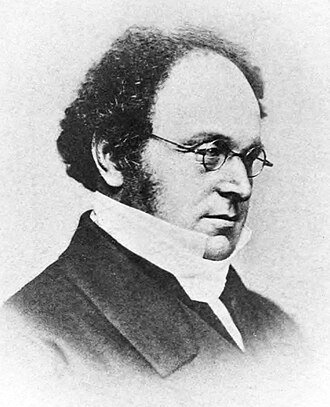
Augustus De Morgan
1806–1871 · British mathematician and logician born in India
Augustus De Morgan (Madurai, India, 1806 – London, 1871) was a British mathematician and logician whose name is attached to one of the best-known results in formal logic. He is remembered above all for De Morgan's laws, which relate conjunction, disjunction and negation, and for giving the name "mathematical induction" to a method of proof whose principles he set out formally. His logical work is now used across set theory, probability and computer science.
He was born in Madurai, in the Carnatic region, into a family tied to the East India Company. His father, a lieutenant-colonel, died when Augustus was ten, and his mother, a granddaughter of James Dodson, who had compiled a table of antilogarithms, took charge of his upbringing. He lost the sight of one eye within months of birth, and the family returned to England when he was still a baby. His mathematical gifts only came to light at fourteen, when a family friend found him drawing a figure from Euclid with ruler and compasses and taught him the ideas behind demonstration. At Trinity College, Cambridge, he came under the influence of George Peacock and William Whewell. He graduated fourth wrangler but refused the theological test needed for a Master of Arts degree, which closed the path to an academic fellowship there and turned him towards law.
In 1828, aged twenty-one, he became professor of mathematics at the newly founded London University, a secular institution open to Catholics, Jews and dissenters. He held the post, with an interruption, until 1866. He was an admired teacher whose courses ran from Euclid to the calculus of variations, and he believed that grasping great principles mattered more than mechanical skill. He wrote textbooks, contributed to the Society for the Diffusion of Useful Knowledge and worked as an actuary for insurance firms. His more original logical work, on symbolical and "double" algebra and on the logic of relations, influenced George Boole and William Stanley Jevons. In 1866 he resigned when the council passed over a Unitarian candidate for a chair in favour of a layman, which he judged a breach of the principle of religious neutrality on which the college had been founded. He died in 1871.
His influence lives on mainly in mathematical logic, where his laws remain basic tools, and in the formalisation of induction as a method of proof.
Key ideas
- De Morgan's laws: the negation of a conjunction is the disjunction of the negations, and the negation of a disjunction is the conjunction of the negations.
- Mathematical induction: a method of proof that establishes a property for a first case and shows that if it holds for one case it holds for the next.
- Symbolical algebra: the manipulation of symbols can be separated from their arithmetic meaning, a step towards abstract algebra.
- Formal logic: relations between propositions and classes can be expressed in a rigorous language, which he developed in Formal Logic.
- Reasoned teaching: learning mathematics means learning to reason, not memorising procedures.
Books to read
- A Budget of Paradoxes, Volume I EnglishEPUB 496 KBRead online
- A Budget of Paradoxes, Volume II EnglishEPUB 463 KBRead online
- First notions of logic (preparatory to the study of geometry) EnglishEPUB 85 KBRead online
Curiosities
A younger Bernoulli
He enjoyed being called the "younger Bernoulli", a reference to the famous family of Swiss mathematicians.
An unattached Briton
He said he was neither English, Scottish nor Irish, but a Briton "unattached", since his father and grandfather had both been born in India.
Teachers and influences
Pupils
- Ada Lovelace 1815–1852
- William Stanley Jevons 1835–1882
Influenced by
- George Boole 1815–1864
Influenced
- Bertrand Russell 1872–1970
Original Filopedia text based on Wikipedia (es) and Wikipedia (en) and Wikidata.