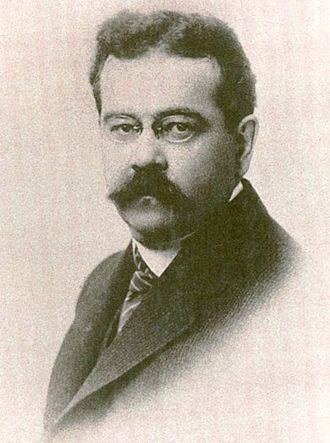
Charles Hoy Fort (Albany, 1874 – the Bronx, 1932) was an American writer and researcher who spent his life gathering anomalous events that science of his day left unexplained. He wrote in English, and his importance lies in turning those neglected reports into a way of questioning the limits of scientific knowledge.
Fort was born in Albany to a family of Dutch descent. His father, a grocer, was an authoritarian man, and in his unpublished autobiography, Many Parts, Fort described the physical abuse he suffered as a child. His biographer Damon Knight suggests that this experience may have fed Fort's distrust of authority. He was self-taught and not a strong student. At eighteen he set out on a journey around the world that ended in illness in southern Africa. In 1896 he married Anna Filing, and the couple lived in poverty in the Bronx while he tried to earn money writing stories for newspapers and magazines. In 1906 he began collecting accounts of anomalies. An inheritance from an uncle later let him leave his day jobs and write full time. He wrote ten novels, but only one was published, and it sold poorly. Between 1920 and 1928 he spent periods in London, working in the Reading Room of the British Museum.
His best-known book, The Book of the Damned (1919), gathered data that science dismissed or ignored, and Theodore Dreiser helped get it published. His style, ironic and provocative, mixed piles of cited cases with mockery of scientific positivism and of newspapers quick to explain everything away. Fort seemed not to take his own speculations seriously, such as the idea of a Super-Sargasso Sea where all lost things end up.
His admirers, who call themselves Forteans, have kept his legacy alive, and some science-fiction writers acknowledged his influence. After his death in 1932, the Charles Fort Society and later the magazine Fortean Times carried his work forward. He probably died of leukemia.
Key works
- The Book of the Damned (1919): a collection of phenomena rejected by science, from showers of frogs to unexplained skies, which Fort sorted into shoeboxes.
- New Lands (1923): a further volume of anomalies and the ironic hypotheses Fort used to interpret them.
- Lo! (1931): a book in which Fort gathers and examines cases he believed conventional science could not explain.
- Wild Talents (1932): his last book, published shortly before his death, on powers and events that escape conventional explanation.
Books to read
- The Book of the Damned EnglishEPUB 325 KBRead online
Curiosities
Burned manuscripts
Discouraged by rejection, Fort burned the manuscripts of two books, X and Y, which dealt with beings on Mars and a civilization at the South Pole. Soon afterward he began The Book of the Damned.
Notes in shoeboxes
Fort kept his notes on cards and scraps of paper in shoeboxes, written in cramped handwriting. Much of this material is now held by the New York Public Library.
Original Filopedia text based on Wikipedia (es) and Wikipedia (en) and Wikidata.