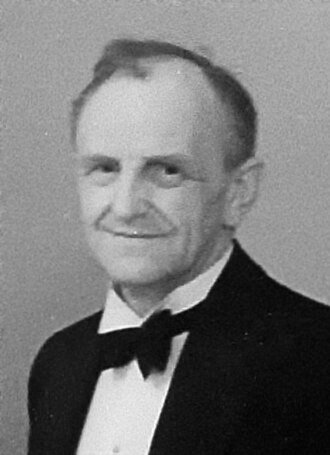
Donald Winnicott
1896–1971 · English paediatrician and psychoanalyst
Donald Woods Winnicott (Plymouth, 1896 – London, 1971) was an English paediatrician and psychoanalyst, one of the most influential figures in object relations theory and developmental psychology. He belonged to the Independent Group of the British Psychoanalytical Society, which stood between the Kleinian and Anna Freudian camps, and he served twice as its president.
He studied medicine at Cambridge and London, a training interrupted by his service as a medical officer in the Royal Navy during the First World War. From 1923 he worked as a paediatrician at the Paddington Green Children's Hospital for some forty years, and in the same year he began his own analysis. During the Second World War he advised on the children's evacuation programme, and between 1943 and 1966 he gave more than sixty radio talks for the BBC. In 1951 he married Clare Britton, a social worker and psychoanalyst who became his most important professional collaborator.
His work centres on the relationship between mother and infant. For him, during the first year of life, mother and baby form a single unit. A "good enough" mother responds to the child's spontaneous gestures and allows a true self, the source of genuine expression, to take shape. When that response repeatedly fails, a false self emerges as a defensive adaptation that protects the authentic core. The infant's gradual disillusionment opens the way to transitional objects, such as a favourite toy, which mediate between inner and outer reality.
In clinical practice, these ideas gave rise to the concept of holding, the support the analyst provides, and to a view of play as a creative space. His influence extends to paediatrics, education and psychotherapy.
Key ideas
- True self: the spontaneous, creative part of the person, which takes root when the mother responds to the child's gestures.
- False self: a defence that adapts to the environment in order to protect the child's authentic core.
- Good-enough mother: the mother who responds to her baby without perfection, letting frustration in gradually.
- Transitional object: the first "not-me" possession, which helps the child move from fusion with the mother towards autonomy.
- Holding: the support the environment provides, which in psychoanalysis extends to the analytic setting.
Curiosities
A diary and a broken collarbone
He first thought of studying medicine at The Leys School after breaking his collarbone, and he recorded in his diary that he wished he could treat himself.
Talks for the BBC
His first radio series, in 1943, was titled "Happy Children". Its success later gave him wide control over the content of his talks.
An early admirer
R. D. Laing, who later became a well-known psychiatrist, wrote to Winnicott in 1958 to acknowledge his help.
Teachers and influences
Influenced
- John Bowlby 1907–1990
- Axel Honneth b. 1949
Original Filopedia text based on Wikipedia (es) and Wikipedia (en) and Wikidata.