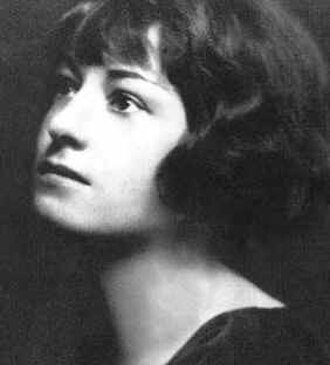
Dorothy Parker
1893–1967 · American poet, short-story writer and critic
Dorothy Parker (born Rothschild in Long Branch, New Jersey, in 1893; died in New York in 1967) was an American poet, short-story writer, theater critic and screenwriter whose name is tied to the sharp humor of New York between the wars. She wrote in English, and her work, marked by irony and disillusion, captured urban life, romantic failure and the position of women in her time. Her importance lies in having turned wit into a serious literary form.
Born Dorothy Rothschild to a family of Jewish descent on her father's side, she lost her mother as a child. After her father died in 1913, she earned her living playing the piano at a dance school while writing verse. Her first poem appeared in Vanity Fair in 1914, and a year later she joined Vogue as an editorial assistant. In 1917 she married the Wall Street broker Edwin Pond Parker II, from whom she separated years before their divorce. At Vanity Fair she worked as a drama critic, a post she lost in 1920 because of the harshness of her reviews.
In the late 1910s she became part of the circle of writers, critics and actors who lunched at the Algonquin Hotel in New York, known as the Algonquin Round Table. Alongside Robert Benchley, Franklin Pierce Adams and others, she gained a reputation for cutting remarks that circulated through newspaper columns and magazines. When Harold Ross founded The New Yorker in 1925, she joined its staff, and she published much of her verse, fiction and criticism there.
Her first book of poems, Enough Rope, came out in 1926 and was widely praised, selling more than forty-seven thousand copies. Over the next fifteen years she published several volumes of verse and stories. Her short fiction is the core of her output: beneath the jokes there is usually a bitter undertow, with characters trapped in failed love affairs, loneliness and the constant nearness of defeat. Big Blonde, which won the O. Henry Award in 1929, is probably her best-known story. She also wrote plays, with little success on Broadway, and book reviews signed as Constant Reader.
In 1934 she married the actor Alan Campbell, and the couple moved to Hollywood, where she worked as a screenwriter and received two Academy Award nominations. Her left-wing views and her work with the Anti-Nazi League led to her being placed on the Hollywood blacklist. She supported the Republican cause during the Spanish Civil War and travelled to Spain; the story Soldados de la República reflects that experience.
Her private life was marked by depression, suicide attempts and drinking, which weighed on her work in later years. She died in 1967 in a New York hotel. She left her estate to the NAACP, and her epitaph, 'Excuse My Dust', keeps the ironic tone for which she was known. Her legacy lives on in the memory of her caustic humor and in her stories, which are now considered among the most perceptive American fiction of her era.
Key works
- Enough Rope (1926), her first book of verse, containing some of her most quoted epigrams.
- Death and Taxes (1931), poems in which humor and despair sit side by side.
- After Such Pleasures (1933), a collection of stories on love and urban loneliness.
- Here Lies (1939), a gathering of her short fiction with new pieces added.
Curiosities
A chosen epitaph
She asked for the words 'Excuse My Dust' on her gravestone. Nobody claimed her ashes for twenty years, until the NAACP bought a grave for them in Baltimore.
A famous couplet
Her two-line poem 'News Item', included in Enough Rope, reads: Men seldom make passes / At girls who wear glasses. It became one of her most remembered epigrams.
An O. Henry Award
The story Big Blonde, published in The Bookman, won the O. Henry Award for the best short story of 1929.
Original Filopedia text based on Wikipedia (es) and Wikipedia (en) and Wikidata.