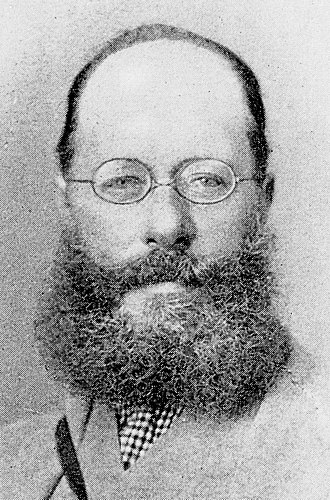
Edward Lear
1812–1888 · English poet, illustrator and painter
Edward Lear (Holloway, 1812 - San Remo, 1888) was an English writer, illustrator and painter, best remembered for his nonsense verse and for the limerick, a five-line comic poem that he popularised although he never used that name. He wrote in an age when science, travel and humour sat side by side in Victorian culture. He matters because he turned nonsense into a literary genre with its own rules, and because his blend of invented words and strong rhythm shaped children's poetry long after him.
He was born into a middle-class family as the penultimate of twenty-one children. The upheaval after the Napoleonic Wars ruined his father's finances as a stockbroker, and at about four Edward moved with his eldest sister Ann, twenty-one years older, who raised him like a mother until her death when he was almost fifty. His health was poor from an early age: he suffered epileptic seizures from the age of six, along with bronchitis and asthma, and from adolescence he endured recurrent depression, which he called "the Morbids". Self-taught, he began at fifteen drawing anatomical illustrations for doctors and later specialised in birds and animals. His first publication, on parrots, appeared in 1830 and was well received. For years he worked at the Earl of Derby's estate drawing animals from his private menagerie, and he is regarded as the first bird artist to paint from living subjects rather than from stuffed specimens.
From 1848 he rarely returned to England. He travelled through Europe, the Holy Land, Egypt and India, sketching in wash on the road and turning those studies into oils, watercolours and prints for his illustrated travel books. His journal of a landscape painter in southern Calabria, from 1852, is among the most admired of his travel writings. He was also a musician: he played the piano above all, composed settings for poems by Tennyson, and sang his own nonsense songs at social gatherings. His friendships ran deep and sometimes painfully. His bond with the young barrister Franklin Lushington included an infatuation that was not returned, and it troubled him for years.
His book The Book of Nonsense, published in 1846, gathered limericks and went through many editions in his lifetime. In 1871 he issued Nonsense Songs, Stories, Botany and Alphabets, which contained "The Owl and the Pussy-Cat", written for the children of his patron. In the 1870s he settled for good in San Remo, in a villa he named after Tennyson, and he died there in 1888. His legacy lies in the English nonsense tradition and in the idea that absurdity can be written with precision and rhythm.
Key works
- The Book of Nonsense (1846)
- Nonsense Songs, Stories, Botany and Alphabets (1871)
- Journal of a Landscape Painter in Southern Calabria (1852)
- Illustrations of the Family of Psittacidae, or Parrots (1830)
Books to read
- Nonsense Books EnglishEPUB 171 KBRead online
- The Book of Nonsense EnglishEPUB 79 KBRead online
- Nonsense Songs EnglishEPUB 104 KBRead online
- A Book of Nonsense EnglishEPUB 81 KBRead online
- Laughable Lyrics EnglishEPUB 90 KBRead online
- More Nonsense EnglishEPUB 83 KBRead online
- The Jumblies, and Other Nonsense Verses EnglishEPUB 82 KBRead online
Curiosities
A cat buried with ceremony
His cat Foss, a companion in San Remo, died in 1887 and was buried with some ceremony in the garden of his villa.
A first seizure at a fair
He had his first seizure at a fair near Highgate, with his father present, an episode that frightened and embarrassed him for the rest of his life.
Original Filopedia text based on Wikipedia (es) and Wikipedia (en) and Wikidata.