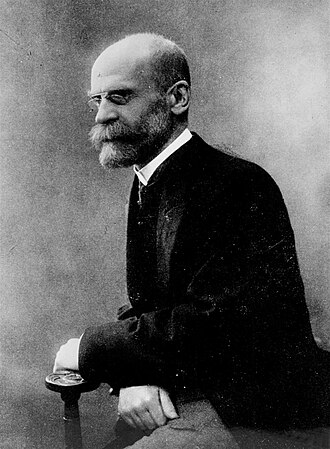
Émile Durkheim
1858–1917 · French sociologist, educator and philosopher who founded academic sociology
Émile Durkheim (Épinal, 1858 – Paris, 1917) was a French sociologist, educator and philosopher. Together with Karl Marx and Max Weber, he is regarded as one of the founders of modern social science, and he is the figure most often credited with establishing sociology as an academic discipline. He belonged to the positivist tradition that begins with Auguste Comte, but he refined it with a method of his own, and his work remains central to the question of how societies hold together.
Born into a Jewish family in Alsace, Durkheim trained at the École normale supérieure, though he turned away from the rabbinical path of his relatives and lived a secular life. He taught philosophy in provincial schools before a stay in Germany in 1885–1886, where he studied at several universities and was impressed by the work of Wilhelm Wundt. In 1887 he was appointed to the University of Bordeaux, where he taught pedagogy and sociology, a subject never before taught in France. There he set up the first sociology department in Europe in 1895. That decade produced his major works: The Division of Labour in Society (1893), his doctoral thesis on social cohesion in modern societies; The Rules of Sociological Method (1895), a manifesto for the discipline; and Suicide (1897), a study of suicide rates among Catholic and Protestant populations that showed how an apparently individual act depends on social conditions. In 1898 he founded the journal L'Année sociologique. He reached the Sorbonne in 1902, and in 1912 he published The Elementary Forms of the Religious Life, which examined the beliefs and rituals of aboriginal societies to explain their social function.
His central claim is that there are social facts: ways of thinking, feeling and acting that exist before each individual, lie outside him and exert a constraining force on his conduct. Language, customs and the monetary system are examples. Sociology, therefore, must study society as a whole and cannot reduce it to the sum of individual behaviour or explain it through psychology. Durkheim distinguished mechanical solidarity, found in small and homogeneous communities and grounded in shared beliefs and values, from organic solidarity, found in industrial societies, where a division of labour creates mutual dependence. To study this solidarity, which he regarded as a moral fact, he proposed looking at the kind of legal sanction a society uses: repressive penal law in traditional societies and restitutive law in modern ones. He also reflected on education as a means of passing on common morality, and on the state, which in his view should confine itself to producing collective representations without absorbing the whole of social consciousness.
His influence is wide. His nephew Marcel Mauss and Maurice Halbwachs were among his circle, and the school known as Durkheimian shaped French sociology and anthropology. Concepts such as collective consciousness have entered everyday language, and his functionalist and structural approach shaped the later development of both disciplines.
Key ideas
- Social fact: ways of thinking, feeling and acting that are external to the individual, precede him and exert a constraining power over his conduct.
- Primacy of society: sociology must study collective phenomena as a whole rather than reduce them to individual psychological data.
- Mechanical and organic solidarity: the cohesion of traditional societies rests on similarity, while that of modern ones rests on the interdependence produced by the division of labour.
- Collective consciousness: the body of shared beliefs and values that sustains social cohesion and comes before individual thought.
- Moral education: the school should transmit the norms and values common to society as a whole, complementing family upbringing.
Books to read
- Le Suicide: Etude de Sociologie FrenchEPUB 466 KBRead online
- Éducation et sociologie FrenchEPUB 144 KBRead online
- The Elementary Forms of the Religious Life EnglishGutenberg
Curiosities
An illustrious nephew
Marcel Mauss, who became a notable social anthropologist, was Durkheim's nephew.
Classmates of note
Durkheim entered the École normale supérieure in 1879, in a class that included Jean Jaurès and Henri Bergson.
Teachers and influences
Teachers
- Wilhelm Wundt 1832–1920
Pupils
- Marcel Mauss 1872–1950
Influenced by
- Montesquieu 1689–1755
- Auguste Comte 1798–1857
- Herbert Spencer 1820–1903
- Louis de Bonald 1754–1840
Influenced
- Jürgen Habermas 1929–2026
- Claude Lévi-Strauss 1908–2009
- Pierre Bourdieu 1930–2002
- Georges Bataille 1897–1962
- Marcel Mauss 1872–1950
- Lucien Lévy-Bruhl 1857–1939
Original Filopedia text based on Wikipedia (es) and Wikipedia (en) and Wikidata.