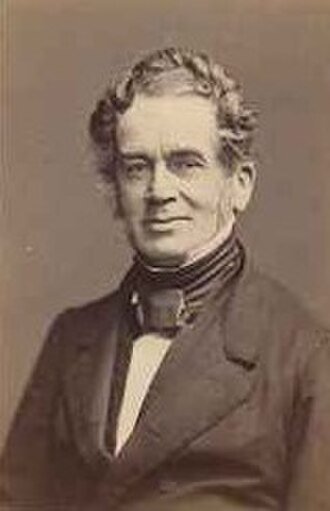
Friedrich Adolf Trendelenburg
1802–1872 · German philosopher and philologist, a modern Aristotelian
Friedrich Adolf Trendelenburg (Eutin, 1802 – Berlin, 1872) was a German philosopher and philologist who sought to revive Plato and Aristotle against the Hegelian system that dominated German universities. His work is usually described as a modern form of Aristotelianism, and it helped to weaken Hegel's influence at the University of Berlin.
Born in Eutin, near Lübeck, he studied at Kiel, Leipzig and Berlin, where Schleiermacher and Hegel were among his teachers. His 1826 doctoral dissertation on Plato's doctrine of ideas and numbers, read through Aristotle's criticisms, set the course of his later work. After declining a chair at Kiel, he spent seven years (1826–1833) as tutor to the son of a close friend of the Prussian minister of education, Karl vom Stein zum Altenstein, and used his free time to prepare a critical edition of Aristotle's De anima. In 1833 Altenstein made him an extraordinary professor in Berlin, and four years later he obtained a full professorship.
Trendelenburg held that thought and being meet in knowledge, and that philosophy should proceed analytically, moving from particular facts toward the universal principles that explain them. He denied that an absolute system was possible, arguing instead for an approximate reconstruction based on the lasting results of historical thought. Motion, he claimed, is the basic fact shared by being and thought, and from it he derived time, space and the categories of mechanics. Yet mechanical causes were not enough: the final interpretation of the universe required the category of end, so that a teleological view of the world outweighed a purely mechanical one. He developed this in his Naturrecht auf dem Grunde der Ethik (1860), where the ethical end is the realization of humanity within the state and history.
He was also a respected teacher who spent much of nearly forty years examining Prussian candidates for the teaching profession in philosophy and pedagogy. Søren Kierkegaard admired his sober scholarship. His 1865 dispute with Kuno Fischer over Kant's doctrine of space became known as the Fischer–Trendelenburg debate. His students included Franz Brentano, and his son Friedrich Trendelenburg became a prominent surgeon.
Key ideas
- Organic view of the world: the final explanation of reality requires the category of end, not only mechanical causes.
- Motion as a shared basis: the motion of the external world corresponds to the constructive activity of perception and thought, and from it time, space and the categories are derived.
- Analytic and approximate method: philosophy rises from particular facts to general principles without claiming a closed, absolute system.
- Platonic-Aristotelian idealism: the ideal shows itself in the real, and philosophy should build on the lasting results of the Platonic-Aristotelian tradition.
- Ethics as culmination: the ethical end is the realization of humanity in the state and in history.
Curiosities
Praise from Kierkegaard
Søren Kierkegaard called Trendelenburg one of the most sober philosophical philologists he knew.
A surgeon son
His son, Friedrich Trendelenburg, became a prominent surgeon, and several medical techniques are named after him.
Teachers and influences
Teachers
- Friedrich Schleiermacher 1768–1834
- Karl Leonhard Reinhold 1757–1823
- Henrik Steffens 1773–1845
Pupils
- Franz Brentano 1838–1917
- Karl von Prantl 1820–1888
Original Filopedia text based on Wikipedia (es) and Wikipedia (en) and Wikidata.