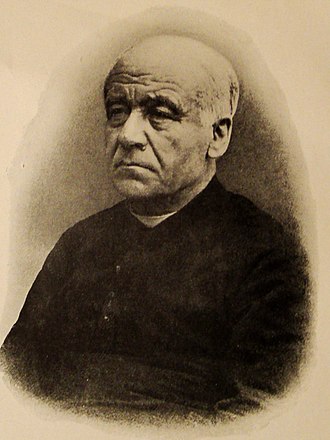
Guido Gezelle
1830–1899 · priest and Flemish poet in Dutch
Guido Gezelle (Bruges, 1830-1899) was a Catholic priest and poet who wrote mainly in Dutch and is among the most important figures in Flemish literature. He matters for his defence of the West Flemish dialects against the Hollandic standard, and for a body of poetry that made language itself feel musical.
Born in Bruges on 1 May 1830 to a gardener and his wife, he grew up in the house that now serves as the Gezellehuis literary museum. He was ordained a priest in 1854 and taught at the minor seminary in Roeselare. There, in 1856, he read Longfellow's The Song of Hiawatha, which he later translated; the translation appeared in 1886. He was also politically engaged, supporting the working poor, a stance that brought him into conflict with parts of the Church.
His poems draw on nature and faith, and often express a mystical love of God and of creation. He wrote compact verses with a strong rhythm and a vocabulary close to the land, celebrating friendship, devotion and solitude. He argued that the Flemish dialects should develop independently rather than bend to the mainstream Dutch of the Netherlands, and his own Dutch is shaped by West Flemish speech, which makes it hard to render in other languages.
His collections Tijdkrans (1893) and Rijmsnoer om en om het jaar (1897) became classics. His musical ear later linked him to literary Impressionism, which regards him as a forerunner. Today he is considered one of the most important poets in Dutch literature. He died in Bruges on 27 November 1899.
Key works
- Kerkhofblommen (1858), poems on religious and natural themes.
- Kleengedichtjes (1860), short and formally concise pieces.
- Tijdkrans (1893), one of his most celebrated collections.
- Rijmsnoer om en om het jaar (1897), poems arranged around the cycle of the year.
Books to read
- Laatste verzen DutchEPUB 146 KBRead online
Curiosities
A writer nephew
His nephew, the Flemish writer Stijn Streuvels, also made his name in literature in the same region.
Hiawatha in Dutch
He read Longfellow's poem in Roeselare in 1856 and later translated it into Dutch, publishing the translation in 1886.
Original Filopedia text based on Wikipedia (es) and Wikipedia (en) and Wikidata.