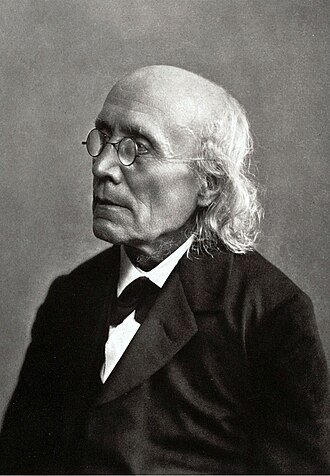
Gustav Fechner
1801–1887 · German physicist, philosopher and experimental psychologist
Gustav Theodor Fechner (1801-1887) was a German physicist, philosopher and experimental psychologist, born in Groß Särchen in Lower Lusatia and active mainly in Leipzig. He stands between the late Enlightenment's philosophy of mind and the scientific psychology of the nineteenth century. He is considered one of the founders of modern experimental psychology, alongside Wilhelm Wundt and Hermann von Helmholtz. His importance lies in arguing that the mind could be measured and treated mathematically, something Kant had regarded as impossible.
The son of a pastor, he grew up in a religious household. Some biographers think he later drifted away from Christianity, while others believe he built a personal system of belief. He studied medicine in Dresden and, from 1818, in Leipzig, where he earned his doctorate and was appointed professor of physics in 1834. In 1839 he damaged his eyes while studying afterimages by staring at the sun through coloured glasses, and he had to give up his post. During his recovery he turned to the study of the mind and its links with the body, giving public lectures. Earlier he had published chemistry and physics papers and translated works by Biot and Thénard. He also wrote poems and humorous pieces, such as the Vergleichende Anatomie der Engel (1825), published under the pseudonym Dr. Mises.
His landmark book, Elemente der Psychophysik (1860), began from a monist view in which bodily and conscious events cannot be reduced to one another but are two sides of one reality. His originality was to seek an exact mathematical relation between them. The result was the Weber-Fechner law, which holds that sensation grows with the logarithm of stimulus intensity. The law works well within certain limits, and S. S. Stevens revised it in 1961 with a power law in his paper “To Honor Fechner and Repeal His Law”. Fechner also developed the statistical notion of the median, explored synaesthesia and experimental aesthetics, and in his posthumous Kollektivmasslehre (1897) introduced the two-piece normal distribution.
His philosophy was animist and panpsychist: he believed the universe was alive throughout and that consciousness could be understood as a kind of wave. He placed humans midway between the souls of plants and those of stars, and conceived God as the soul of the universe. This side of his work had fewer followers than his psychophysics. His influence is mainly methodological. Ernst Mach drew on his psychophysics, William James admired his work and wrote an introduction to one of his books in 1904, and Sigmund Freud refers to him when discussing psychic locality in The Interpretation of Dreams.
Key ideas
- Psychophysics: the discipline that seeks precise mathematical relations between physical stimuli and the sensations they produce.
- The Weber-Fechner law: sensation grows logarithmically with stimulus intensity, a relation that holds only within certain limits.
- Psychophysical monism: body and consciousness are two sides of one reality, though neither can be reduced to the other.
- Panpsychism: the whole universe is animated and has some form of inner life, against the material view of science in his day.
Curiosities
A humorous pseudonym
He published his humorous work Vergleichende Anatomie der Engel (1825) under the name Dr. Mises.
A musical admirer
The composer Gustav Mahler read Fechner as a student and identified with him while writing his Second and Third Symphonies and Das Lied von der Erde.
A hypothesis later supported
Fechner speculated that cutting the corpus callosum would create two separate streams of consciousness. In the twentieth century, Roger Sperry and Michael Gazzaniga found evidence supporting this idea in epileptic patients.
Teachers and influences
Pupils
- Hermann Lotze 1817–1881
Influenced by
- Immanuel Kant 1724–1804
Influenced
- Hermann Ebbinghaus 1850–1909
- Friedrich Paulsen 1846–1908
Original Filopedia text based on Wikipedia (es) and Wikipedia (en) and Wikidata.