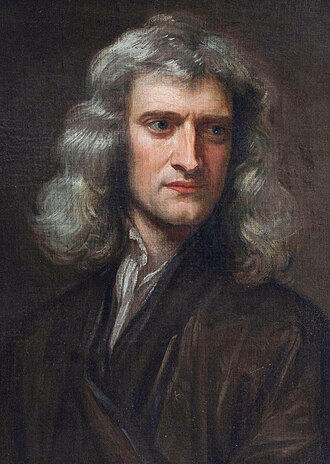
Isaac Newton
1643–1727 · English physicist, mathematician and astronomer
Isaac Newton (Woolsthorpe, 1643 - London, 1727) was an English physicist, mathematician, astronomer and theologian, a central figure of the Scientific Revolution and of the Enlightenment that followed. He is best known for classical mechanics and the law of universal gravitation, but he also worked on optics, alchemy and biblical chronology. He is widely regarded as one of the most influential minds in the history of modern thought.
He was born on 25 December 1642 under the Julian calendar then used in England, which corresponds to 4 January 1643 in the Gregorian calendar. He arrived prematurely and was very small, and his father had died three months earlier. When he was three, his mother, Hannah Ayscough, remarried the Reverend Barnabas Smith, and the boy was left in the care of his maternal grandmother. Newton never warmed to his stepfather. In a list of sins he wrote as a young man, he recorded a threat to burn his stepparents and their house, a sign of the resentment he carried from those years.
He attended The King's School in Grantham, where he learned Latin, Greek and the basics of mathematics. After a reluctant spell trying to become a farmer, he went back to school and became its top pupil. In 1661 he entered Trinity College, Cambridge, where he read Aristotle alongside modern writers such as Descartes and Galileo. In 1665, with the university closed because of plague, he retreated to Woolsthorpe. The two years that followed are often considered the most productive of his career. There he sketched out calculus, advanced the binomial theorem, studied light and developed his ideas on gravitation.
His best-known work, the Mathematical Principles of Natural Philosophy, published in 1687, argues that the same kind of law governs a falling stone and the motion of the planets. His three laws of motion and his law of universal gravitation explained Kepler's planetary orbits, the tides and the paths of comets, and they ended doubts about the heliocentric system. Newton did not see physics as a set of loose qualitative explanations. He treated it as a mathematical description of forces and motion that observation could test.
In optics, he showed with a prism that white light splits into the colours of the spectrum, and that those colours belong to the light itself rather than to the glass. This work was collected in his book Opticks, published in 1704, and led him to build a reflecting telescope. He also worked on fluid mechanics, studied the speed of sound and formulated a law of cooling. In mathematics he shares credit with Leibniz for the development of calculus, and he also contributed the binomial theorem and the Newton-Cotes formulas.
His interests went well beyond science. He spent much time on alchemy and biblical chronology, though most of this writing stayed unpublished long after his death. He was a fellow of Trinity College, the Lucasian Professor of Mathematics, and from 1703 president of the Royal Society. In his last decades he lived in London, where he ran the Royal Mint and helped improve the accuracy and security of British coinage. He died in 1727 and became the first scientist buried in Westminster Abbey.
His influence was immense. His synthesis of mechanics served as the foundation of physics for more than two centuries, until relativity showed its limits at speeds close to that of light and in intense gravitational fields. For most everyday phenomena, however, his laws remain a reliable approximation. His way of combining observation, experiment and mathematics shaped the scientific method as we know it today.
Key ideas
- Universal gravitation: the same attraction governs falling bodies on Earth and the motion of the heavenly bodies.
- Laws of motion: three principles describing how a body's motion changes when a force acts on it.
- Nature of light: white light contains all the colours of the spectrum, and these do not come from the prism.
- Mathematical physics: describing forces and motion with equations that observation can test.
Books to read
- Opticks : or, A treatise of the reflections, refractions, inflections and colours of light EnglishEPUB 278 KBRead online
- Philosophiae Naturalis Principia Mathematica LatinEPUB 436 KBRead online
- Newton's Principia : The mathematical principles of natural philosophy EnglishEPUB 642 KBRead online
- Observations upon the Prophecies of Daniel, and the Apocalypse of St. John EnglishEPUB 248 KBRead online
- The Chronology of Ancient Kingdoms Amended To which is Prefix'd, A Short Chronicle from the First Memory of Things in Europe, to the Conquest of Persia by Alexander the Great EnglishEPUB 290 KBRead online
Curiosities
Name on the desks
According to school tradition, Newton carved his name into every desk he occupied during his studies, and some of these carvings are still preserved.
A list of sins
Among the sins he recorded from his youth is a threat to burn his stepparents and their house, which shows how lasting his resentment was.
Teachers and influences
Teachers
- Isaac Barrow 1630–1677
Pupils
- William Whiston 1667–1752
Influenced by
- René Descartes 1596–1650
Influenced
- Albert Einstein 1879–1955
- Voltaire 1694–1778
- Immanuel Kant 1724–1804
- David Hume 1711–1776
- Neil deGrasse Tyson b. 1958
- Émilie du Châtelet 1706–1749
- David Brewster 1781–1868
- John Theophilus Desaguliers 1683–1744
- William Whiston 1667–1752
Original Filopedia text based on Wikipedia (es) and Wikipedia (en) and Wikidata.