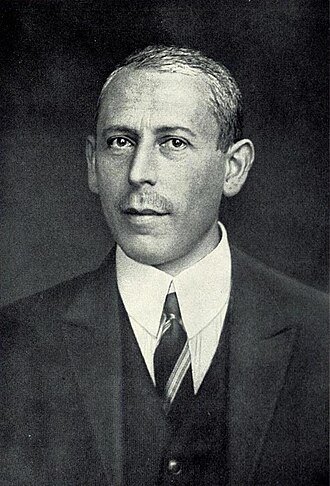
Karl Abraham
1877–1925 · German psychoanalyst and close collaborator of Sigmund Freud
Karl Abraham (Bremen, 1877 – Berlin, 1925) was one of the first German psychoanalysts and one of Sigmund Freud's closest followers, with whom he kept a long correspondence. Freud once called him his 'best pupil'. His work belongs to the early years of psychoanalysis, and it is central to the development of the theory of psychosexual stages.
The son of a Jewish religion teacher, he studied medicine and in 1901 obtained a post at the Burghölzli Swiss Mental Hospital, where Eugen Bleuler worked. It was in that setting that he first encountered psychoanalysis, through Carl Gustav Jung. In 1907 he settled in Berlin and met Freud in person, who drew him into his inner circle. In 1910 he founded the Berlin Psychoanalytic Society and became the first German analyst to run a private psychoanalytic practice. At the Munich congress of 1913 he led the opposition to Jung, and he served as president of the International Psychoanalytical Association in 1918 and again in 1925.
His best-known contribution concerns childhood as the root of mental disorder. Abraham described the oral and anal stages of development. He argued that fixation at one of these stages shapes character: optimism or pessimism in the oral stage, and frugality, orderliness and obstinacy in the anal stage, with obsessional neurosis as a possible result of anal fixation. He also proposed splitting each of these stages into two substages. He studied manic-depressive illness through the case of the painter Giovanni Segantini, and held that melancholic depression is not explained by a real loss alone but by disappointments in early childhood, in men always linked to the mother. This idea of a pre-Oedipal "bad" mother differed from Freud's Oedipal mother and prepared the ground for Melanie Klein, who was his patient in 1924 and 1925. His short study of the development of the libido extended Freud's reflections on mourning and melancholia.
Abraham also turned to culture. Like Jung and Otto Rank, he tried to explain myths and folk traditions through psychoanalytic theory, and he wrote on the Egyptian pharaoh Amenhotep IV. He died young, in 1925, from complications of a lung infection. His influence was considerable: he mentored Karen Horney, Helene Deutsch and Franz Alexander, and his notion of the pre-Oedipal mother and his account of developmental stages remain part of the history of psychoanalysis.
Key ideas
- Oral and anal stages: psychosexual development unfolds in stages, and fixation at one of them shapes character and may favour mental disorders.
- The pre-Oedipal mother: in melancholic depression early disappointments with the mother matter, an approach that anticipates Melanie Klein's ideas.
- Loss and melancholia: a real loss is not enough on its own to explain depression; the vicissitudes of object relations play a part.
- Childhood sexual trauma: Abraham considered sexual abuse in childhood common among neurotic and psychotic patients.
- Psychoanalysis and culture: myths and folk traditions, in his view, express the childhood wishes of peoples.
Books to read
- Psycho-Analysis and the War Neuroses EnglishGutenberg
Curiosities
A nickname from Freud
Freud referred to Abraham as 'my best pupil', a sign of the close relationship the two kept over the years.
A ring of trust
Abraham was one of the members of the so-called Committee of the Seven Rings, each of whom received a ring from Freud as a symbol of trust.
Original Filopedia text based on Wikipedia (es) and Wikipedia (en) and Wikidata.