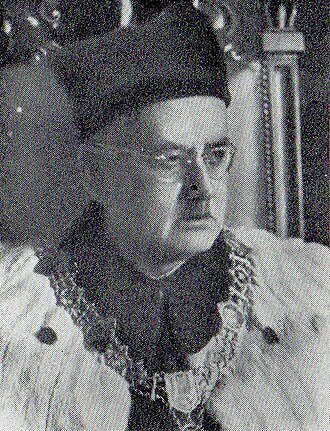
Kazimierz Ajdukiewicz
1890–1963 · Polish philosopher and logician of the Lwów–Warsaw school
Kazimierz Ajdukiewicz (Ternopil, 1890 – Warsaw, 1963) was a Polish philosopher and logician and one of the leading figures of the Lwów–Warsaw school. His work centred on semantics, model theory and the philosophy of science. He is best known for categorial grammar, a framework for analysing syntax that still shapes work in formal linguistics.
He was born in Tarnopol, then part of Galicia within Austria-Hungary, into a family of civil servants. After childhood years in Kraków and Lwów, he studied philosophy, physics and mathematics at the university in Lwów, where he came under the influence of Kazimierz Twardowski and the circle that later gave the school its name. He earned his doctorate in 1912 with a thesis on Kant's philosophy of space. In 1913–1914 he attended lectures in Göttingen by Husserl, Nelson and Hilbert. During the First World War he fought in the Austro-Hungarian army and later in the Polish army, serving as an artillery officer in the Polish–Soviet War.
His first major epistemological proposal, which he called radical conventionalism, treated a language as a system of axiomatic, deductive and empirical rules linking expressions to one another and to experience. He argued that these rules could not fully govern scientific language, which also depended on a conceptual apparatus and on a choice of problems. He abandoned this view in the late 1930s and turned to categorial grammar, built on the idea that syntactic units combine through function and argument relations. The approach drew on Husserl's pure logical grammar and was later given a formal structure by Carnap.
Ajdukiewicz taught at Lwów, Poznań and Warsaw, edited Studia Logica for many years and served as rector of the University of Poznań from 1948 to 1952. His influence lives on mainly in formal logic, semiotics and the methodology of science, and in formal linguistics, where categorial grammar remains a point of reference.
Key ideas
- Radical conventionalism: the view that knowledge depends on inferential rules of meaning and on a chosen conceptual apparatus, so that even reports of experience are open to these decisions.
- Categorial grammar: a syntactic system in which categories combine through function and argument relations, used to analyse the structure of natural languages.
- Methodology of science: the logical study of how scientific theories are built and validated and how their terms relate to one another.
- Formal semantics: the analysis of expression meaning through logic and model theory.
Original Filopedia text based on Wikipedia (es) and Wikipedia (en) and Wikidata.