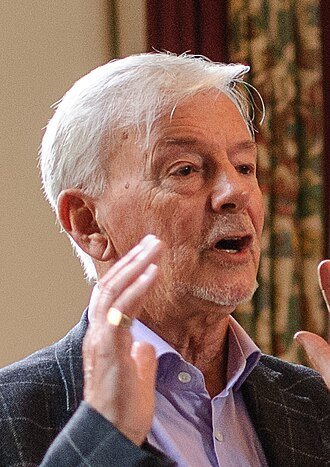
John Stephen Keith Ward (born 1938 in Hexham) is a British philosopher and theologian, a fellow of the British Academy and a priest of the Church of England. He is best known for his work in comparative theology, the philosophy of religion and the relationship between science and faith, an area in which he has argued that reason and belief can coexist.
He studied in Wales, Oxford and Cambridge and taught at Glasgow, St Andrews, London and Cambridge. From 1991 to 2004 he was Regius Professor of Divinity at Oxford, and in 1993-1994 he delivered the Gifford Lectures, published as Religion and Revelation. His outlook shifted noticeably in the 1990s: having been a prominent defender of evangelical conservatism in the 1970s, he moved towards a more critical reading of scripture, a change that cost him many former friends in that camp.
His thought centres on the concept of God, revelation and the compatibility of evolution with Christianity, set out in God, Chance and Necessity. His best-known works include The Concept of God, God, A Guide for the Perplexed and Is Religion Dangerous? His influence reaches into British public debate, where he has contested atheist positions such as that of Richard Dawkins, and into English-language academic theology.
Key ideas
- God as a rational foundation: he holds that the existence of God can be defended by philosophical argument, not by faith alone.
- Evolution and faith: he regards evolution and Christianity as essentially compatible, a position he calls theistic evolution.
- Revelation and scripture: the Bible should be taken seriously but not always literally, and it need not contain errors that mislead about salvation.
- Dialogue between religions: he proposes understanding religious traditions in mutual dialogue as a route to comparative theology.
Original Filopedia text based on Wikipedia (es) and Wikipedia (en) and Wikidata.