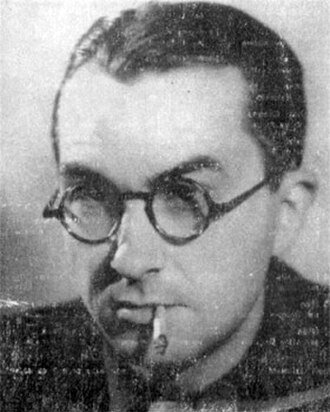
Paul Nizan (Tours, 1905 – Dunkirk, 1940) was a French philosopher and writer of the first half of the twentieth century. His work sits at the meeting point of philosophy, the novel and communist militancy, and he is best remembered for his polemics against the philosophy taught in French universities and for his portrayal of social alienation.
The son of a railway engineer, he studied at the Lycée Henri-IV in Paris, where he befriended Jean-Paul Sartre, and later entered the École Normale Supérieure, where he crossed paths with Raymond Aron. In his youth he briefly joined Georges Valois's French fascist movement before turning to communism in 1927. That same year he went to Aden as a tutor, an experience that became the basis of his first book, Aden Arabie (1931), whose opening line, "I was twenty", would later be quoted by young protesters for decades.
In 1932 he published Les Chiens de garde, a polemic against former teachers such as Bergson and Brunschvicg, questioning the role of academic philosophy as a tool of the ruling class. Antoine Bloyé (1933) explored class betrayal, the story of a man who climbs the social ladder and leaves his origins behind; critics later saw it as one of the first French novels of socialist realism. He also wrote The Trojan Horse and The Conspiracy (1938), and worked as a literature teacher while writing for the Communist Party press.
Nizan left the party after the Molotov–Ribbentrop Pact of 1939, not out of moral judgment of the USSR but because he disagreed with the party's sharp change of line against the Popular Front. Soon afterwards he enlisted in the French army and was killed in May 1940 during the German offensive against Dunkirk.
His influence has been uneven. He was rediscovered in 1960, when Sartre wrote the foreword to a new edition of Aden Arabie, and his critique of academic idealism and social alienation continues to be read by those interested in postwar existentialism and political commitment.
Key ideas
- Class betrayal: social advancement can mean abandoning one's origins and one's original class.
- Critique of academic philosophy: philosophy as taught in France, he argued, often justified the existing social order.
- Alienation: bourgeois life and professional careers separate the individual from real experience and from their class.
- Political commitment: literature and thought should serve a concrete social transformation.
Curiosities
A sentence turned into a slogan
The opening of Aden Arabie, "I was twenty", was quoted decades later by students during the May 1968 protests.
Sartre's schoolmate
He met Jean-Paul Sartre at the Lycée Henri-IV in Paris in 1917, a friendship that lasted for life.
Original Filopedia text based on Wikipedia (es) and Wikipedia (en) and Wikidata.