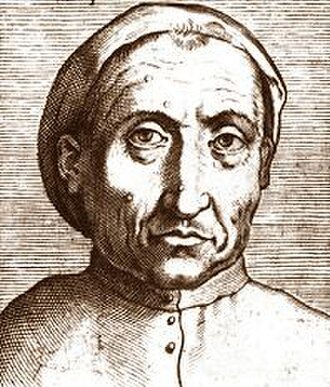
Pietro Pomponazzi
1462–1525 · Italian Renaissance philosopher and Aristotelian
Pietro Pomponazzi (Mantua, 1462 – Bologna, 1525) was an Italian philosopher and one of the central figures of Renaissance Aristotelianism. Trained and teaching at the University of Padua, he is remembered above all for his reading of Aristotle on the soul, at a time when scholastic thought, closely tied to Thomas Aquinas, dominated university teaching.
After years at Padua, where he taught natural philosophy and succeeded his teacher Nicoletto Vernia, he briefly taught in Ferrara and, from 1511, settled in Bologna, where he wrote most of his major works and stayed until his death. His best-known treatise, De immortalitate animae (1516), argued that, following Aristotle, the human soul depends entirely on the body and perishes with it. He rejected Averroes's idea of a single immortal intellect shared by all humanity, and also Aquinas's view, siding instead with the line of Alexander of Aphrodisias. To avoid censure, he carefully separated the domains of reason and faith: immortality, he held, was an article of faith rather than something philosophy could prove.
His most original contribution is arguably ethical. If virtue depended on reward or punishment beyond the grave, it would no longer be virtue in the full sense. Pomponazzi maintained that the reward of virtue is virtue itself, which makes the person who practises it happy. Morality needed no support from fear or hope, and the goal of human life was moral happiness rather than knowledge. Some interpreters see here an early form of the moral autonomy later developed by thinkers such as Spinoza and Kant.
His De incantationibus, published after his death, sought to explain through natural causes phenomena attributed to the stars, demons or miracles, and for this reason it was placed on the Index of prohibited books. His influence reached pupils such as Girolamo Fracastoro and Gasparo Contarini, and his defence of an independent philosophy that could coexist in tension with faith shaped Renaissance debates on reason and religion.
Key ideas
- Mortality of the soul: for Pomponazzi, the human soul depends on the body and does not survive it.
- Immortality as faith: immortality may be believed, but reason cannot demonstrate it.
- Moral autonomy: virtue is its own reward and needs neither prize nor punishment.
- Natural causes: phenomena attributed to stars, demons or miracles admit natural explanations.
Curiosities
Three marriages
He married three times. The first, in 1500, was to Cornelia Dondi dall'Orologio, with whom he had two daughters.
Works published after his death
His De incantationibus and his treatise on fate and free will were published posthumously in Basel, possibly because he feared they would inflame the controversy over the immortality of the soul.
A calm farewell
According to a witness to his final days, on his last night he said he was departing happily for the place where all mortals go.
Teachers and influences
Influenced
- Giulio Cesare Vanini 1585–1619
- Roberto Ardigò 1828–1920
Original Filopedia text based on Wikipedia (es) and Wikipedia (en) and Wikidata.