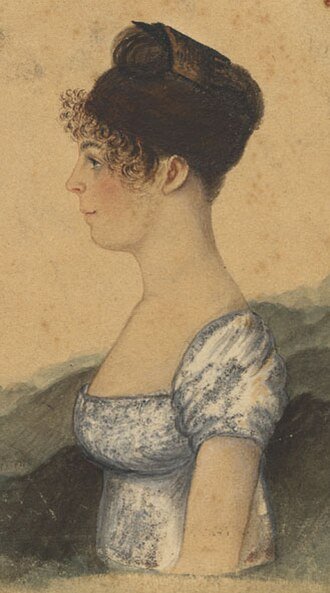
Susanna Rowson
1762–1824 · Anglo-American novelist, poet and educator
Susanna Rowson (Portsmouth, 1762 – Boston, 1824) was a novelist, poet, playwright, actress and educator who was born in England and spent most of her career in the United States. She wrote in English while American literature was still taking shape, and she is remembered as one of the first women geographers and an early advocate of schooling for girls.
She reached Massachusetts as a child in 1767, when her father took up a post as a customs officer. The Revolution sent the family back to England in 1778, and they struggled financially afterwards. While working as a governess in Westminster she published her first book, and in 1791 came Charlotte: A Tale of Truth, which circulated in America as Charlotte Temple and sold steadily for decades. She and her husband then turned to the stage in Edinburgh, Philadelphia and Boston, where she wrote plays and songs and performed dozens of roles.
In 1797 she opened one of Boston's early academies for girls, which later moved to Medford and Newton before returning to the city. In 1805 she published a geography textbook focused on human geography, which also criticised the damage slavery caused. Her legacy lies in sentimental fiction, women's education and the early literature of the United States, and she is still remembered chiefly for Charlotte Temple.
Key works
- Charlotte Temple (1791): a novel about a young woman's seduction and its consequences, widely read in America.
- Trials of the Human Heart (1795): a sentimental novel weighing love, duty and moral dilemmas.
- Slaves in Algiers; or, A Struggle for Freedom (1794): a play about captivity and liberty, with active female characters.
- An Abridgement of Universal Geography (1805): a textbook on human geography describing societies and how they are organised.
Books to read
- Charlotte Temple EnglishEPUB 157 KBRead online
Curiosities
A "little scholar"
In Massachusetts, the politician James Otis, a friend of the family, took a special interest in the girl's education and called her his "little academic".
A cenotaph after a demolition
When St. Matthew's Church was demolished in 1866, the remains in the vault, no longer distinguishable, were moved together to Mount Hope Cemetery, and a cenotaph was later erected at Forest Hills.
Original Filopedia text based on Wikipedia (es) and Wikipedia (en) and Wikidata.