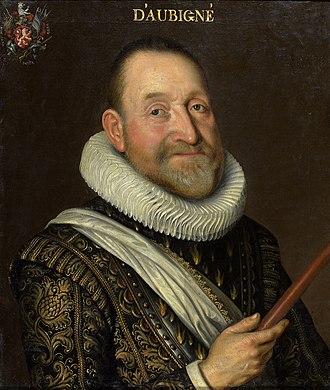
Agrippa d'Aubigné
1552–1630 · French poet, soldier and chronicler of the Baroque era
Théodore Agrippa d'Aubigné (1552-1630) was a French poet, soldier and chronicler of the Baroque period. A committed Protestant and trusted companion of Henry of Navarre, he is remembered above all for Les Tragiques, an epic poem in alexandrines written during the French Wars of Religion and regarded as one of the masterpieces of its age.
He was born near Pons, into a Calvinist family. His father had taken part in the Amboise conspiracy of 1560, and the boy was marked by the sight of the conspirators' heads displayed after the reprisals. By his own account, he had mastered Latin, Greek and Hebrew as a small child. His education took him through Paris, Orléans and Geneva, where he studied under Theodore Beza.
In 1573 he joined Henry of Navarre, serving him as a soldier and adviser. His blunt manner and biting sarcasm made him many enemies at court, and he never forgave the king for converting to Catholicism. After Henry's assassination in 1610 he lost his place at court, withdrew to his estates and devoted his final years to writing.
His Histoire universelle, published between 1616 and 1620, attacked the regency of Marie de' Medici with unusual boldness. Parliament banned it, and the author, outlawed in 1620, settled in Geneva, where he remained until his death in 1630. There he also wrote memoirs for his children and the satires of Les aventures du baron de Faeneste, which mock the vanities of courtiers.
Les Tragiques blends tragedy, satire and apocalyptic vision. Divided into seven books, it presents the religious wars as a long catalogue of wrongs leading to a final judgement. Its style is rough, emphatic and often violent, far removed from the polish of Ronsard and the Pléiade poets he opposed.
For centuries he was little read. The Romantics, led by Victor Hugo and Sainte-Beuve, rediscovered him, and he has since been regarded as the great epic poet of French Protestantism. Baudelaire chose an excerpt from Les Tragiques as the epigraph to Les Fleurs du mal, a sign that his influence reached modern poetry.
Key works
- Les Tragiques (1616), an epic poem in alexandrines on the Wars of Religion and the final judgement of France.
- Histoire universelle depuis 1550 jusqu'en 1601 (1616-1620), a critical chronicle of the court and politics of his time, banned by parliament.
- Les Aventures du baron de Faeneste (1617), a satire of courtly vanity.
Curiosities
An early education
By his own account, he knew Latin, Greek and Hebrew at the age of six, and had translated Plato's Crito before he turned eleven.
The heads of Amboise
On a journey through Amboise, his father showed him the heads of the executed conspirators on the scaffold and urged him to avenge them.
Original Filopedia text based on Wikipedia (es) and Wikipedia (en) and Wikidata.