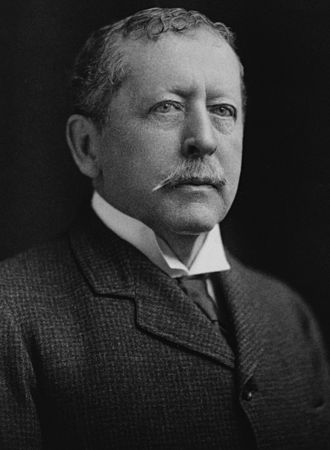
Thomas Bailey Aldrich
1836–1907 · American poet, storyteller and editor
Thomas Bailey Aldrich (Portsmouth, New Hampshire, 1836 – Boston, 1907) was a nineteenth-century American poet, storyteller and, above all, editor. He wrote in English, and his importance rests on two things: light, precisely crafted lyric poetry, and a children's novel that gave its name to the "bad boy" subgenre. For almost a decade he also ran one of the most influential literary magazines in Boston.
He spent much of his childhood in New Hampshire, though his father moved the family's base to New Orleans for a time. Aldrich was sent back to Portsmouth to prepare for college, but he gave up those studies after his father died in 1849. In 1852 he joined an uncle's business office in New York and began writing regularly for newspapers and magazines. In the early 1860s he moved in the city's bohemian circles, where he befriended young writers and poets, Walt Whitman among them. During the Civil War he edited the New York Illustrated News, and in 1865 he settled in Boston.
His work moves between verse and prose. His early stories and poems have a calm realism and restrained humour, seen clearly in Marjorie Daw and Other People (1873). The Story of a Bad Boy (1870), drawn partly from his own youth, set the template for the mischievous-boy novel. His longer novels, such as Prudence Palfrey (1874), have more dramatic action. In verse he paid close attention to form, and critics linked him to Robert Herrick. He was openly critical of the dialect poetry that was so popular at the time, and he preferred a cleaner poetic language.
From 1881 to 1890 he edited The Atlantic Monthly. The job brought him into conflict with his publisher, Henry Oscar Houghton, after he refused articles that Houghton had commissioned from friends. After a further dispute, he resigned in June 1890. In 1865 he had married Lilian Woodman, and they had two sons. One of them, Charles, died of tuberculosis in 1904, after the family had spent time in Saranac Lake, a leading centre for treating the disease.
Aldrich never reached the fame of some of his better-known contemporaries. His legacy lies in his disciplined lyric verse, in the children's novel that inspired later writers, and in his editorship, which gave space to new voices in American letters, including Charles W. Chesnutt.
Key works
- The Ballad of Babie Bell (1856): one of his early volumes of verse, which established him as a lyric poet.
- The Story of a Bad Boy (1870): a semi-autobiographical novel that gave its name to the "bad boy" subgenre of American literature.
- Marjorie Daw and Other People (1873): a collection of stories with calm realism, quiet humour and surprise endings.
- Prudence Palfrey (1874): a novel set in Portsmouth, with more dramatic action than his shorter tales.
Books to read
- The Story of a Bad Boy EnglishEPUB 216 KBRead online
Curiosities
A resignation after an editorial dispute
Aldrich left The Atlantic Monthly in 1890 after arguing with his publisher, Henry Oscar Houghton, over his refusal to print pieces Houghton had commissioned from friends.
A scathing remark from Mark Twain
In 1893 Mark Twain wrote a harsh letter about Aldrich's wife, Lilian, whom he considered unbearable.
His last words
He died in Boston in 1907, and his last words were recorded as: "In spite of it all, I am going to sleep; put out the lights."
Original Filopedia text based on Wikipedia (es) and Wikipedia (en) and Wikidata.