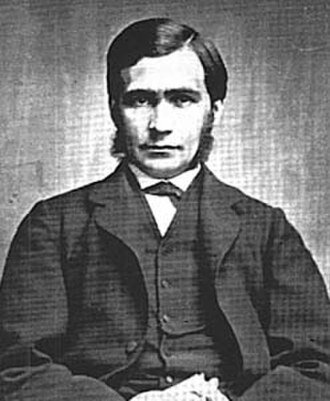
Thomas Hill Green
1836–1882 · British idealist philosopher and Oxford professor
Thomas Hill Green (1836-1882), known as T. H. Green, was an English philosopher and a central figure of British idealism. He worked in the second half of the nineteenth century, when the empiricism of Hume and the evolutionary ideas of Herbert Spencer shaped much of English thought. Green opposed both currents, and his work affected philosophy as well as the political debate of his time.
Born in Birkin, in Yorkshire, he was first educated at home and then at Rugby. In 1855 he entered Balliol College, Oxford, becoming a fellow in 1860, and from 1878 until his death he held the chair of moral philosophy. His lectures gave rise to his two main works, the Prolegomena to Ethics and the Lectures on the Principles of Political Obligation, both published after his death. He was also active in local life, in temperance societies and in the campaign to extend the franchise.
His starting point was a critique: if the mind were merely a collection of isolated sensations, knowledge and moral conduct would make no sense. Against this he argued that experience implies a consciousness that relates what it perceives, so that reality is an intelligible system of relations. In ethics, the same reason that grounds knowledge also reveals the human good, and freedom consists in identifying oneself with rational ends rather than in doing whatever one pleases.
In politics, together with Bernard Bosanquet, he developed what is called organic liberalism. In this view the state may act positively to promote individual self-realisation, by curbing economic monopolies, reducing poverty and protecting people who cannot work through illness, unemployment or old age. Green also linked liberalism with the widening of democracy. His thought is regarded as one of the roots of New Liberalism, alongside Leonard Trelawny Hobhouse.
Key ideas
- Critique of empiricism: the mind is not a set of isolated sensations but a consciousness that relates what it perceives.
- Eternal consciousness: reality is an intelligible system of relations sustained by a consciousness that knows it as a whole.
- Rational freedom: freedom consists in identifying oneself with rational ends that one recognises as one's own.
- Organic liberalism: the state should act actively to promote individual self-realisation and social justice.
Curiosities
Ancestry
On his father's side, Green was descended from Oliver Cromwell.
A large funeral
About 2,000 townspeople of Oxford attended his funeral, in addition to friends from his academic life.
Somerville
Green and his wife, Charlotte Byron Symonds, a promoter of women's education, helped found Somerville Hall, later Somerville College.
Teachers and influences
Influenced
- Samuel Alexander 1859–1938
Original Filopedia text based on Wikipedia (es) and Wikipedia (en) and Wikidata.