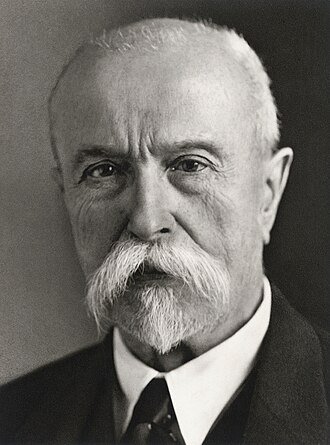
Tomáš Garrigue Masaryk
1850–1937 · Czechoslovak philosopher and statesman, first president of Czechoslovakia
Origins and family
Tomáš Garrigue Masaryk was born on 7 March 1850 in Hodonín, in Moravia, then part of the Austrian Empire. He came from a modest background: his father, Jozef Masárik, was of Slovak origin and worked as a carter and later as steward and coachman on an imperial estate; his mother, Teresie Kropáčková, was Moravian and had received a German education. This double heritage, Czech and Slovak, would shape his whole career. He grew up in the village of Čejkovice before moving to Brno to study.
Education
After completing secondary schooling in Brno and Vienna between 1865 and 1872, he entered the University of Vienna, where he studied under Franz Brentano. In 1876 he earned his doctorate with a thesis on Plato, on the essence of the soul from an empirical standpoint. From 1876 to 1877 he studied at the University of Leipzig under Wilhelm Wundt and came into contact with Edmund Husserl. In 1879 he qualified as a university lecturer in Vienna with a work on suicide as a mass social phenomenon of modern civilization, a subject through which he linked the act to subjectivism and the loss of religious faith.
Family life and early academic career
In Leipzig he had met Charlotte Garrigue, an American citizen, whom he married in New York on 15 March 1878. As a sign of recognition toward her, Masaryk adopted his wife's maiden name, Garrigue. The couple lived in Vienna until 1881 and then settled in Prague. In 1882 he was appointed professor of philosophy at the Czech-language part of Charles University. The following year he founded Athenaeum, a journal devoted to Czech culture and science, whose first issue appeared in October 1883.
Thought and intellectual work
His philosophy rested on a rational theism combined with a cultural Christianity. He rejected divine revelation and religious mysticism, preferring to examine the psychological and ethical dimensions of social phenomena. He taught the history of philosophy, logic, ethics and the foundations of sociology and psychology, devoting particular attention to David Hume and Blaise Pascal. He believed that social problems and political conflicts arose from ignorance and that a scientific study of their causes would reveal solutions, so he saw himself as an educator who had to rouse the public from apathy. He also promoted the influence of French and Anglo-American thought on Czech culture and was among the initiators of the first universal encyclopedia in Czech. He challenged the authenticity of the so-called Manuscripts of Dvůr Králové and Zelená Hora, epic poems that expressed a nationalist Czech chauvinism he opposed.
Political career and the Hilsner case
In 1891 he entered the Austrian Reichsrat as a deputy of the Young Czech Party, and from 1907 to 1914 he sat again, this time for the Czech Progressive Party he had founded in 1900. During this period he identified with the Habsburg monarchy: he rejected Czech national radicalism and favoured the gradual democratisation of the empire and the strengthening of the economic and cultural position of the Czech nation within it. As a liberal democrat he criticised communism, absolutism, antisemitism and clericalism, and gave close attention to the social and workers' question. His visits to Russia led him to denounce antidemocratic tendencies in both tsarist and Bolshevik Russia, and he set out his views on the Slavic question in the 1913 book Russia and Europe.
In 1899–1900 he became a defender of human rights by taking up the case of Leopold Hilsner, a Jew accused of ritual murder amid widespread antisemitism and a hostile public. Masaryk was one of the few who rejected the accusation outright, and he secured the commutation of the death sentence to life imprisonment, saving Hilsner's life.
Exile and the creation of Czechoslovakia
When the First World War broke out in 1914, Masaryk concluded that the best course was to seek independence for Czechs and Slovaks from Austria-Hungary. He went into exile in December of that year and travelled through Western Europe, the Russian Empire, the United States and Japan, organising Czechs and Slovaks abroad and building contacts that proved decisive. He was central to the creation of the Czechoslovak Legion, which fought alongside the Allies and at one point controlled much of Siberia. He argued that the Czechoslovak people had to be the authors of their own liberation rather than wait for other countries to help. In 1918, together with Edvard Beneš and Milan Rastislav Štefánik, he travelled to the United States and won the support of President Woodrow Wilson, leading to the Washington Declaration proclaiming the independence of the new state. With the fall of Austria-Hungary, the Czechoslovak Republic was recognised by the Allied powers and Masaryk became head of its provisional government.
Presidency and legacy
He was elected president on 14 November 1918 by the National Revolutionary Assembly, since the new state still lacked constitutional institutions. He returned to Prague on 21 December of that year and was re-elected in 1920, 1927 and 1934. During his tenure Czechoslovakia consolidated itself as a stable democratic state. He resigned in December 1935 for reasons of health and was succeeded by Beneš. He retired to Lány and died on 14 September 1937, at the age of 87.
His reputation has had its ups and downs. Under the communist regime his name was removed from books and his statues were destroyed; after the fall of communism his importance in Czech history was restored, and the Czech Republic still identifies with his legacy. In 1990 the Order of Tomáš Masaryk was established, one of the country's highest official honours, which may be conferred posthumously.
Key ideas
- Rational theism: belief in a God accessible to reason, without recourse to revelation or mysticism, in dialogue with a Christianity understood as a cultural tradition.
- The modern crisis: the loss of faith and modern subjectivism were seen as affecting both the individual and society, and needed rigorous diagnosis.
- Ethics and social psychology: collective phenomena were analysed through their psychological and moral components, as in his study of suicide.
- Liberal democracy: he defended pluralism, public education and gradual progress against absolutism, authoritarianism and antisemitism.
- Independence of small nations: he held that small peoples had to win their liberation themselves, and that self-determination was both a moral and a practical demand.
Curiosities
A borrowed surname
As a tribute to his wife, Charlotte Garrigue, he began to use her maiden name.
A posthumous honour
The Order of Tomáš Masaryk, established in 1990, can be awarded posthumously, which is unusual among decorations in other countries.
Teachers and influences
Teachers
- Franz Brentano 1838–1917
Original Filopedia text based on Wikipedia (es) and Wikipedia (en) and Wikidata.