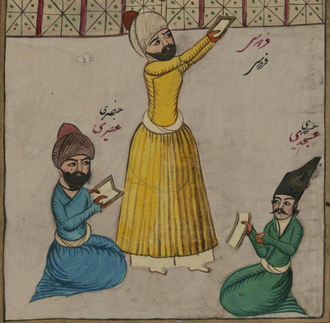
Unsuri
970–1039 · Persian poet of the court of Mahmud of Ghazni
Abu'l-Qasim Hasan Unsuri, usually known simply as Unsuri, was one of the leading Persian poets of his time. He lived at the close of the tenth century and into the early eleventh, a period when Persian was establishing itself as a literary language. He is said to have been born in Balkh, in what is now Afghanistan, though this rests more on tradition than on firm documentary evidence.
His career unfolded mainly at the court of Sultan Mahmud of Ghazni, who gathered many poets around him. There Unsuri received the title Malik us-Shu'ara, or King of Poets, a sign of the standing he enjoyed among his contemporaries. His divan is said to have held some 30,000 couplets, spanning qasidas, ghazals, quatrains and masnavis, which is to say most of the verse forms that Persian poets practised at the time. Only about 2,500 couplets survive, so it is difficult to judge his style and the range of his themes with real precision.
Among the works attributed to him is the romance epic Vamiq u 'Adhra, which ultimately derives from the ancient Greek novel Metiochus and Parthenope. Its origin shows how Persian literature of the period borrowed stories from other traditions and reshaped them in its own language and metre.
His legacy is tied to the brilliance of the Ghaznavid court and to the early flowering of Persian poetry after the Islamic conquest. Because much of his output has been lost, his influence is known mainly through later writers who cited him and through the reputation he kept.
Key works
- Divan, a poetry collection of which about 2,500 couplets survive out of the 30,000 once attributed to it; date not known.
- Vamiq u 'Adhra, a romance epic, date not known, which derives from the Greek novel Metiochus and Parthenope.
Curiosities
Prince of poets
At the court of Mahmud of Ghazni he was given the title Malek-us Sho'ara, meaning "prince of poets".
A divan almost lost
His divan is said to have contained some 30,000 couplets, yet only about 2,500 have survived.
Original Filopedia text based on Wikipedia (es) and Wikipedia (en) and Wikidata.