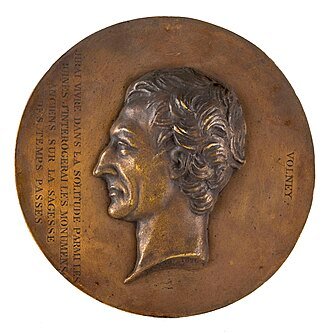
Constantin-François Chassebœuf
1757–1820 · French philosopher, orientalist and politician of the late Enlightenment
Constantin-François Chassebœuf, Count Volney (Craon, 1757 – Paris, 1820), was a French writer, philosopher, orientalist and politician. Heir to the rationalism of Helvétius and Condorcet, he combined the study of ancient civilisations with a critique of religion and political inequality, which makes him a notable figure of revolutionary thought.
He first studied law and then medicine, and in Paris he frequented the salons of Madame Helvétius at Auteuil and of Baron d'Holbach, where he met Cabanis, Condorcet, Diderot and Benjamin Franklin. These friendships strengthened his materialism and atheism. After studying Arabic, he travelled through Egypt, Syria and Palestine between 1782 and 1785, and later published an account of the journey in 1788. Around that time he had adopted the pen name Volney, a blend of Voltaire and Ferney.
During the Revolution he was elected to represent the Third Estate at the Estates General of 1789 and served as secretary of the National Constituent Assembly. In 1791 he published The Ruins, a meditation on the rise and fall of empires that imagines a general assembly of free and equal nations. Its tolerant atheism and its defence of liberty led to its place on the Catholic Church's Index of prohibited books. During the Terror he was imprisoned, and in 1795 he travelled to the United States, where he befriended Thomas Jefferson and aroused the suspicions of John Adams.
He returned to France and initially supported Napoleon, who made him a count, though he distanced himself after the Concordat. Under Louis XVIII he sat in the Chamber of Peers without abandoning his liberal convictions. His scholarly work includes a study of Herodotus's chronology (1781), New Researches on Ancient History (1814) and writings on Hebrew. His influence was felt in the historical criticism of religion and in nineteenth-century progressive thought, and he was also one of the earliest proponents of the Christ myth theory.
Key ideas
- Materialism and atheism: reality is explained by matter and nature, without any need for gods or revelation.
- Rational morality: morality should rest on reason and social necessity rather than superstition.
- Comparative history of empires: the rise and fall of civilisations stem from human and political causes and can be studied as such.
- Liberty, equality and universal peace: he proposed a general assembly of nations that would guarantee equality among peoples.
Books to read
- The Ruins; Or, Meditation on the Revolutions of Empires and the Law of Nature EnglishEPUB 308 KBRead online
- Les Ruines, ou méditation sur les révolutions des empires FrenchEPUB 357 KBRead online
Curiosities
A pen name with a tribute
He took the name Volney, a contraction of Voltaire and Ferney, the town where Voltaire spent the last years of his life.
Almost adopted sons
Madame Helvétius came to regard Cabanis and him almost as adopted sons, since both had lost their mothers in childhood.
A schoolboy nickname
His classmates called him 'the hermit' because of his studious and solitary nature.
Original Filopedia text based on Wikipedia (es) and Wikipedia (en) and Wikidata.