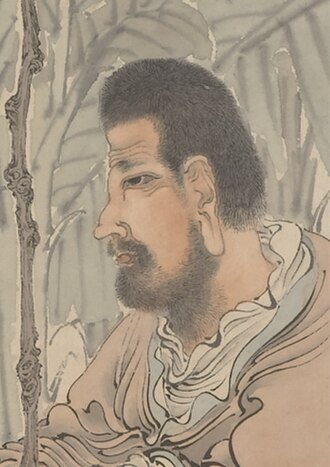
Zhi Dun
314–366 · Buddhist monk and Chinese philosopher of the Jin dynasty
Zhi Dun (314-366), also known by his courtesy name Daolin, was a Buddhist monk and philosopher in China during the Jin dynasty. He belonged to the educated class, and his work helped shape the early spread of Buddhism in China, since he combined training in Neo-Daoist thought with monastic life. Born into a family surnamed Guan, he took the surname Zhi when he was ordained, borrowing it from his preceptor.
He was one of the so-called gentleman-monks, men from aristocratic families who became influential Buddhist monks in the fourth century. His education covered the secular arts, Neo-Daoism, pure conversation and the exegesis of texts. Few of his writings survive, but they are known to have addressed the metaphysical meaning of the term li and the relation between emptiness and matter. He also wrote eulogies and poems, and in one of them he expressed his faith in Amitabha and the Pure Land of Sukhavati, one of the earliest surviving examples of Pure Land devotion in China.
His influence lies in how Buddhism was absorbed into Chinese thought through concepts familiar to scholars. Much of his work was lost, but it survives in later compilations, and he is often seen as a bridge between the Chinese intellectual tradition and Buddhist doctrine.
Key ideas
- Neo-Daoism applied to Buddhism: he read Buddhist concepts through the metaphysical vocabulary of Neo-Daoism, which helped Buddhism win acceptance among Chinese scholars.
- The term li: he explained its metaphysical meaning as an ideal, noumenal principle underlying phenomena.
- Emptiness and matter: his writings connected Buddhist emptiness with matter, seeking language his readers would understand.
- The Pure Land: he voiced a devotional faith in Amitabha and the Paradise of Sukhavati, anticipating a current that would later become very influential.
Curiosities
The Two Cranes
According to an anecdote recorded in the Shishuo Xinyu, a friend gave him two young cranes. Seeing them despondent after he had clipped their wings, he let them fly away once their feathers had grown back, feeling they should not be kept as pets.
An Early Link with Korea
He wrote a letter to a monk from Koguryŏ, the first recorded connection between Koguryŏ and Buddhism.
Original Filopedia text based on Wikipedia (en) and Wikidata.