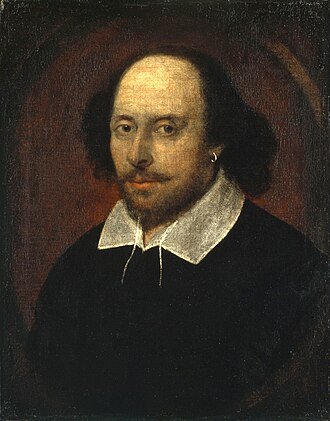
 AuthorWilliam Shakespeare1564–1616
Antony and Cleopatra is a tragedy by William Shakespeare, probably written between 1606 and 1607, although some scholars argue it may date from around 1603 or 1604. It was first performed around 1607 or 1608 and first appeared in print in the First Folio of 1623, under the title The Tragedie of Anthonie, and Cleopatra. Its main source is Thomas North's 1579 English translation of Plutarch's Life of Marcus Antonius, from which Shakespeare borrows many phrases almost verbatim, including the famous description of Cleopatra's barge given by Enobarbus.
The play follows the relationship between Mark Antony, one of the triumvirs of Rome alongside Octavius Caesar and Lepidus, and the Queen of Egypt, from the Parthian campaign to Cleopatra's suicide after the war of Actium. Seduced by Cleopatra, Antony neglects his political and military duties. Called back to Rome, he marries Octavia, Octavius's sister, in an attempt to seal the alliance between the two men, but soon returns to Cleopatra. The conflict with Octavius ends with the naval defeat at Actium, the desertion of Enobarbus and Antony's death in Cleopatra's arms. Refusing to be paraded in triumph in Rome, she takes her own life with the bite of an asp.
The tragedy is notable for its fragmented structure: it contains forty brief scenes, more than any other play by the author, which shift rapidly between Alexandria, austere and pragmatic Rome, Sicily, Athens and Syria. This alternation sets the sensual, imaginative world of Egypt against the discipline of Rome. Its genre is difficult to fix, since it can be read as a history play, a tragedy, a comedy or a romance, and some critics regard it as a problem play.
Cleopatra is often considered one of Shakespeare's most complex female characters. She is capricious, theatrical and at times bordering on the ridiculous, yet the playwright also grants her a tragic grandeur equal to Antony's. This ambivalence has divided critics for centuries. Often regarded as a sequel to Julius Caesar, the play has inspired countless stage and film adaptations and remains one of Shakespeare's great Roman dramas.
Themes
Books to read
- Antony and Cleopatra EnglishEPUB 200 KBRead online
Other works by William Shakespeare
- A Midsummer Night's Dream 1600
- The Merchant of Venice 1600
- Hamlet 1602
- King Lear 1608
- Othello, the Moor of Venice 1622
- Macbeth 1623
- The Tempest 1623
- Twelfth Night 1623
- As You Like It 1623
- Romeo and Juliet
- Julius Caesar
Original Filopedia text based on Wikipedia (es) and Wikipedia (en) and Wikidata.