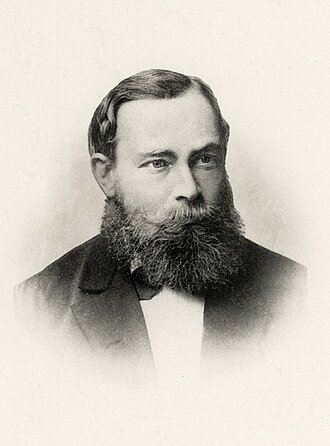
 AuthorGottlob Frege1848–1925
Begriffsschrift, published by Gottlob Frege in 1879, is a book on logic and the formal system it sets out. Its full title presents it as "a formula language, modeled on that of arithmetic, for pure thought." It is usually rendered in English as "concept writing" or "concept notation." Frege shared with Leibniz the wish for a logical calculus that could express reasoning with the precision of mathematics. In the foreword, however, he denied having reached that goal, and also denied that his aim was to build an ideal universal language like Leibniz's, a task he judged hard and somewhat idealistic, though not impossible.
The system is essentially a classical bivalent second-order logic with identity. It is bivalent because its formulas denote either truth or falsehood; it is second-order because it includes relation variables alongside object variables and allows quantification over both; and it includes the identity relation. It also contains the first appearance of quantified propositional variables. Its notation is two-dimensional and idiosyncratic: connectives and quantifiers are expressed through strokes linking formulas, rather than through the symbols now standard. Frege defined the conditional in terms of negation and the affirmation or denial of its components, and he stated nine propositions as axioms, justifying them informally as self-evident given their meanings.
Frege later applied this calculus in his investigations into the foundations of arithmetic, in The Foundations of Arithmetic. The third chapter deals with what is now called the ancestral of a relation, a tool that later became central to defining the natural numbers. The work is generally regarded as the beginning of analytic philosophy, a tradition that Bertrand Russell and Ludwig Wittgenstein developed in the following decades. Wittgenstein, in the Tractatus, paid homage to Frege by using the term Begriffsschrift as a synonym for logical formalism. Later, in his 1892 essay "On Sense and Reference," Frege qualified some of the book's conclusions about identity, holding that the identity predicate expresses a relation between the objects denoted by names rather than between the names themselves.
Themes
Other works by Gottlob Frege
Original Filopedia text based on Wikipedia (es) and Wikipedia (en) and Wikidata.