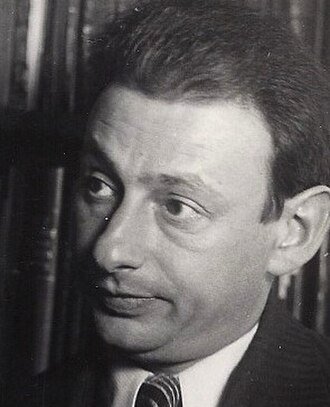
 AuthorGershom Scholem1897–1982
Major Trends in Jewish Mysticism is a 1941 work by Gershom Scholem on the history of the Jewish Kabbalah. Its contents were first assembled as a series of lectures given in 1938 at the Jewish Theological Seminary in New York, where Scholem had been invited by Shalom Spiegel to teach a course on Kabbalah. Two of the eleven chapters had been delivered on other occasions, as Scholem notes in the foreword. In a letter to Walter Benjamin in March 1938, Scholem reported that he had finished his lectures and would use the rest of his stay to review the Kabbalistic manuscripts in the seminary library. The political climate of those months, marked by events in Germany and the annexation of Austria, forms a backdrop to the lectures.
In his introduction, Scholem blames Jewish scholars of the Haskalah for their hostility and neglect of Kabbalah, which left the field almost monopolized by "charlatans and dreamers". The book traces Merkabah mysticism and Jewish gnosticism, focusing on the Lesser and Greater Hechalot, tracts written between the 2nd and 6th centuries, along with other texts such as Shiur Koma, the Book of Enoch, the Sefer Yetzirah and the Sefer ha-Bahir. Citing other scholars, Scholem notes parallels between the Sefer Yetzirah and early Islamic gnosticism. He then turns to the German Jewish Hasidim and to Abraham Abulafia, and gives his most detailed analysis to the Zohar, the best known work of Jewish mysticism. The book closes with the teachings of Isaac Luria, Sabbatai Zevi, and the Eastern European Hasidic movement.
Themes
Original Filopedia text based on Wikipedia (en) and Wikidata.