Skin in the Game
popular nonfiction essay on risk, incentives and accountability · 2018
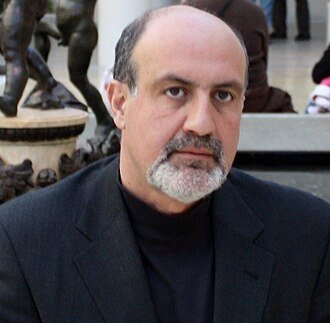 AuthorNassim Nicholas Talebb. 1960
Skin in the Game: Hidden Asymmetries in Daily Life is a nonfiction book published in 2018 by Nassim Nicholas Taleb, a former options trader with a background in probability and statistics. It belongs to the Incerto, Taleb's multi-volume philosophical essay on uncertainty, alongside Fooled by Randomness, The Black Swan, The Bed of Procrustes and Antifragile. The book is dedicated to Ron Paul and Ralph Nader, whom Taleb praises as men of courage.
Its central thesis is that having skin in the game, that is, sharing the risk of an important decision, is necessary for fairness, commercial efficiency and risk management, and even for understanding the world. Taleb argues that the economic problem is not merely missing incentives but an asymmetry: some actors collect the rewards while others bear the losses. A fund manager paid a percentage of gains but not penalized for losses has every reason to gamble with other people's money. For the author, the remedy is to make decision-makers pay for their mistakes, a measure he considers more effective than thousands of laws and regulations. He also offers an evolutionary argument: those who err without consequences survive longer than they should, and without penalties natural selection and market selection cannot work.
The book gathers examples such as executives who earned large sums without suffering losses during the 2008 crisis, which Taleb calls "Bob Rubin trades", or war advocates who never face any personal risk. It also develops the notion of the "Intellectual Yet Idiot", aimed at educated and prestigious people who offer opinions without answering for their advice. Another key idea is minority rule: a stubborn minority, sometimes a small percentage of the population, can impose its habits on everyone else when accommodating it is simpler than maintaining alternatives.
The book received sharply divided reviews. Some critics praised its ambition to join empirical experience with ethical reflection; others noted that many ideas persuade in the abstract but weaken when applied to particular cases. The term "Intellectual Yet Idiot" also entered American political debate in 2016.
Themes
Other works by Nassim Nicholas Taleb
Original Filopedia text based on Wikipedia (en) and Wikidata.