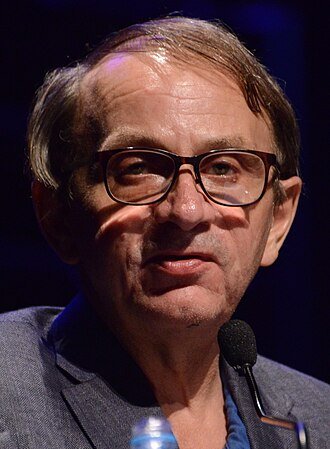
 AuthorMichel Houellebecqb. 1956
Submission (in French, Soumission) is a political fiction novel by Michel Houellebecq, published on 7 January 2015 by Flammarion. The book imagines a France in which, in the 2022 presidential election, a Muslim party with Islamist and patriarchal values defeats the National Front candidate with the support of the Socialists and parts of the traditional right. Its publication coincided with the attack on the offices of Charlie Hebdo, which gave it an exceptional resonance and turned it into a major public debate.
The narrator and protagonist is François, a literature professor at the Sorbonne who specialises in the decadent writer Joris-Karl Huysmans. His intellectual and emotional life has stalled: his relationships are passing affairs with students, and for years he has produced no work of real significance. As the political crisis deepens, his young Jewish girlfriend, Myriam, emigrates to Israel with her parents, and the death of his own parents leaves him in a void that makes him fear for his own life. He seeks refuge in an abbey, the same place where Huysmans became a lay oblate.
Once in power, President Mohammed Ben Abbes pacifies the country and carries out sweeping reforms: he privatises the Sorbonne, which becomes an Islamic university where only Muslims may teach, abolishes gender equality and permits polygamy. His ultimate project is to enlarge the European Union to take in North Africa and the Middle East and turn it into a new empire of Islamic character, with France at its centre. François, stripped of his post but not entirely deprived of its privileges, ends up courted by former colleagues who have converted to Islam, who offer him a well-paid position and the prospect of marrying women chosen for him. The novel closes with his inclination towards that conversion, seen as a second chance at life.
The work mixes fiction with real figures such as Marine Le Pen, François Hollande, François Bayrou, Manuel Valls and Jean-François Copé, who appear briefly. Its tone blends satire, reflection on contemporary nihilism and the register of a comic novel, which has led readers to see it both as a political portrait and as a meditation on desire, submission and the meaning of a civilisation.
The book was an immediate success: more than 120,000 copies sold in the weeks after publication, over 345,000 in France within a month, and it was a bestseller in Italy and Germany. Some critics compared it to Jean Raspail's The Camp of the Saints and to George Orwell's 1984. Its portrayal of Islam and of women provoked strong criticism: sectors of the left accused it of Islamophobia, and several reviewers pointed to a misogynistic outlook. Others read it as a satire of nihilism and of modern man. It inspired a stage monologue and a German film adaptation.
Themes
Other works by Michel Houellebecq
- Whatever 1994
- Atomised 1998
- Platform 2001
- The Possibility of an Island 2005
- The Map and the Territory 2010
- Annihilation 2022
Original Filopedia text based on Wikipedia (es) and Wikipedia (en) and Wikidata.