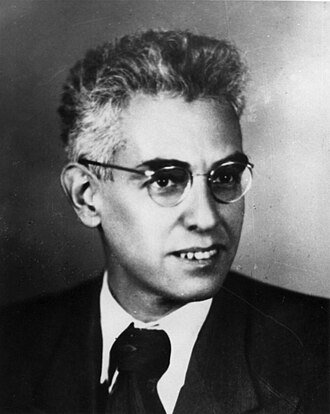
Alexander Luria
1902–1977 · Soviet neuropsychologist and physician, often called the father of modern neuropsychology
Alexander Romanovich Luria (Kazan, 1902 – Moscow, 1977) was a Soviet neuropsychologist and physician of Jewish origin, widely regarded as one of the founders of neuropsychology and cognitive neuroscience. Trained in the cultural-historical tradition alongside Lev Vygotsky, with whom he worked from the mid-1920s, he built a body of work that connected the study of the human mind with the study of brain injury.
Born into a family with many doctors, he studied at Kazan State University before moving to Moscow in 1923, where he met Vygotsky and other psychologists of his generation. Before the war his interests lay in the cultural development of thought, and his studies of Uzbek populations with little formal schooling became well known. He completed his medical degree in 1937.
The Second World War was the turning point. He was tasked with caring for nearly 800 patients with brain wounds from the war, and out of this work came his major books, Traumatic Aphasia (1947) and Higher Cortical Functions in Man (1962), the latter supplemented by The Working Brain in 1973. To assess these patients he devised an extensive battery of neuropsychological tests, many of which are still used in adapted forms.
His central idea is straightforward: complex mental functions do not sit in a single spot in the brain but arise from systems of areas working together, which may lie far apart. A symptom therefore shows that a system has broken down, but it does not by itself reveal where the function resides. Luria also argued that these systems change with development and learning, and he described three functional units: one regulating waking and sleep, one receiving and processing information, and one programming and checking one's own activity.
His influence reaches clinical neuropsychology, the rehabilitation of people with brain injuries, and later cognitive psychology. His case studies, such as those of the mnemonist Shereshevsky and of Lev Zasetsky, are still read well beyond specialist circles.
Key ideas
- Functional systems: complex mental functions depend on networks of brain areas that work together, not on isolated regions.
- Dynamic localization: the organization of these systems changes during child development and learning.
- The meaning of a symptom: losing a function shows that the system has failed, but it does not by itself reveal where that function is located.
- Three functional units: regulating arousal and sleep, receiving and storing information, and programming and monitoring one's own activity.
- Hierarchical organization: each unit is structured into primary, secondary and tertiary zones, with the tertiary zones responsible for the most complex forms of mental activity.
Curiosities
A wartime assignment
During the Second World War he was assigned the care of nearly 800 patients with traumatic brain injuries, work that shaped the rest of his career.
A student of Vygotsky
He met Lev Vygotsky in Moscow in 1924, and their collaboration gave rise to what is known as the Vygotsky–Luria circle.
Teachers and influences
Teachers
- Lev Vygotsky 1896–1934
Influenced by
- Lev Vygotsky 1896–1934
Original Filopedia text based on Wikipedia (es) and Wikipedia (en) and Wikidata.