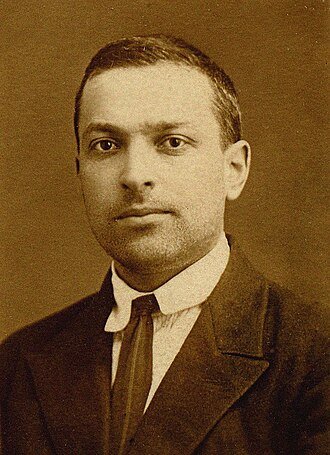
Lev Vygotsky
1896–1934 · Belarusian psychologist, founder of cultural-historical psychology
Origins and education
Lev Semyonovich Vygotsky was born on November 17, 1896, in Orsha, in the Mogilev Governorate of the Russian Empire, in what is now Belarus. He came from a non-religious, middle-class Jewish family; his father, Simkha Leibovich, was a banker. He was raised in Gomel, where he was home-schooled until 1911 and then earned a degree with distinction from a private Jewish gymnasium. As a teenager he was passionate about theatre and painting, and at nineteen, in 1915, he wrote an essay on Hamlet. According to tradition, he changed his original surname, Vygodsky, to Vygotsky, though the reasons are unclear.
In 1913 he entered Moscow University through a lottery, since a three percent quota applied to Jewish students. Under his parents' insistence he first enrolled in medicine and soon switched to law, while attending lectures at the Shanyavsky People's University, a liberal institution that admitted women and people of any religion. His real interests lay in the humanities and social sciences.
Early career
After the October Revolution, the restrictions against Jews were lifted, and Vygotsky became involved in political life. In Gomel he became a central figure in the city's intellectual and cultural activity: he taught Russian grammar and literature at a workers' school, psychology and logic at the teacher-training institute, aesthetics and art history at the conservatory, directed the theatre section of a newspaper and founded a literary magazine. He read Marx, Engels, Spinoza, Hegel, Freud, Pavlov and the linguist Potebnya during these years.
In 1919 he contracted tuberculosis and in 1920 was placed in a sanatorium. Aware that his life would be short, he intensified his work. At the teacher-training institute he set up a psychology laboratory to study children from kindergartens who had learning delays, and the material from this work fed into his book Educational Psychology, published in 1926. In 1924 he married Rosa Smekhova, and they had two daughters.
Moscow and the research group
In January 1924, at the Second All-Russian Psychoneurological Congress in Petrograd, he presented an essay on methods of reflexological and psychological research. There he met Alexander Luria, who helped him obtain a post at the Psychological Institute in Moscow, directed by Konstantin Kornilov, leader of the Marxist current in psychology. At the institute he worked alongside Luria and Alexei Leontiev, both somewhat younger and later internationally recognised. Together they sought to reformulate psychology on Marxist foundations and to devise pedagogical strategies against illiteracy and against defectology, the term then applied to children considered abnormal or difficult.
In 1925 he founded a laboratory of child psychology for abnormal children, later transformed into the Institute of Experimental Defectology. That same year he attended, as a delegate, an international congress on the education of the deaf in England, his only trip abroad; on the way he visited Germany, the Netherlands and France. On his return he suffered a serious relapse of tuberculosis, and in hospital he wrote his dissertation, The Psychology of Art, defended in the autumn but not published in his lifetime. He was hospitalised again in 1926, when he wrote an essay on the historical meaning of the crisis in psychology, which was also not published then.
Core ideas
The fundamental idea of his work is that human development can only be explained through social interaction. For Vygotsky, the child appropriates cultural tools, such as language, which at first belong to the group into which the child is born and reach the child through relationships with others. Mental abilities are not biologically given but built through tools and signs that turn social relations into psychological functions. From this come his concepts of mediation and internalisation.
Among his best-known contributions is the zone of proximal development, the distance between what a child can solve alone and what they can reach with the help of a more capable partner. He also saw play as a privileged space in which the child practises mediation. His work covered the origin of higher mental functions, the relationship between thought and language, the formation of concepts, the psychology of art and learning disorders.
Criticism, censorship and final years
From 1928 his group began to fragment. After a conflict with Kornilov, the team's activities were curtailed at the institute. In 1929 he was invited to Tashkent to train teachers and psychologists, and in 1930 he led a seminar in Moscow with Luria, Eisenstein and the linguist Marr. In 1931 criticism of his cultural-historical theory began, and the group dispersed: Luria, Galperin and Zaporozhets moved to Kharkiv, while Vygotsky travelled regularly to Leningrad. In 1933 he undertook a major synthesis of his work to answer his critics, which became Thinking and Speech. In spring 1934 he was hospitalised and dictated the final chapter from his bed; the book was published shortly after his death, with vetoes and cuts, under the title Thought and Language.
Vygotsky died in Moscow on June 10, 1934, aged 37, from a relapse of tuberculosis. His ashes were buried at Novodevichy Cemetery. Some of his works were cut by censorship from 1936 and denounced as anti-Marxist by the Stalinist authorities, although his theories were never entirely absent from public discussion. His bibliography includes around 180 titles, of which eighty remained unpublished. He was recognised and widely disseminated in the Western world from the 1960s onward, and his prolific output and early death earned him the nickname "the Mozart of psychology", coined by Stephen Toulmin.
Legacy
His work has had enormous influence on developmental psychology, education and the study of language. His leading interpreters are James Wertsch in the English-speaking world and Ángel Rivière in Spain. Vygotsky creatively integrated very diverse fields of knowledge and gave new meaning to the role of society, culture and language in human development. His cultural-historical theory, also known today as activity theory, remains a central reference for understanding learning as a social process.
Key ideas
- The social origin of mind: mental abilities are not fixed by biology alone; they form through using language and cultural tools in interaction with others.
- Mediation: signs and cultural tools stand between a person and the world, and their internalization is the route of psychological development.
- Zone of proximal development: the distance between what a child can solve alone and what they achieve with help from someone more capable.
- Play: for Vygotsky, play is a space where children practise mediation and move beyond their everyday behaviour.
Curiosities
Hamlet at nineteen
In 1915, at only nineteen, he wrote an essay on Hamlet, an early sign of his interest in literature and theatre.
A respelled surname
He chose to spell his surname Vygotsky rather than Výgodskiy, and the reason for the change is not entirely clear.
Teachers and influences
Pupils
- Alexander Luria 1902–1977
Influenced by
- Benedictus de Spinoza 1632–1677
Influenced
- Alexander Luria 1902–1977
- Lucien Sève 1926–2020
Original Filopedia text based on Wikipedia (es) and Wikipedia (en) and Wikidata.