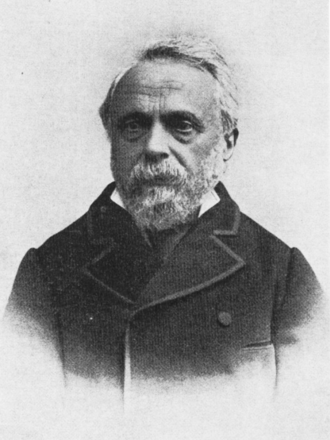
Ambroise-Auguste Liébeault
1823–1904 · French physician, founder of the Nancy School of hypnosis
Ambroise-Auguste Liébeault (1823-1904) was a French physician often regarded as the father of modern hypnotherapy. He practised in Nancy, in eastern France, and is best remembered for co-founding with Hippolyte Bernheim the Nancy School, which studied hypnotic suggestion as a therapeutic tool.
Born in Favières, in the Lorraine region, he came from a comfortable farming family and trained in medicine at Strasbourg, where he read a book on animal magnetism that caught his interest. Once established as a doctor, he began trying hypnosis on willing patients, at first with little success or public acceptance. Over time his results drew local attention and the interest of other practitioners. In 1866 he published Du sommeil et des états analogues, a poorly written work that sold badly, and a later book met with similar indifference.
His central claim was that hypnosis was a normal property of the human body rather than a pathology akin to hysteria, as the Salpêtrière school held. In his view, a person's ease in becoming hypnotised tracked their general suggestibility.
His influence proved far greater than his early sales suggested. Bernheim took up his work, and through him ideas reached figures such as Sigmund Freud, spreading across Europe.
Key ideas
- Suggestion as the basis of hypnosis: the hypnotic effect arises from suggestions the therapist gives the patient.
- Hypnosis as a normal state: anyone can enter it, and it is not a sign of illness.
- General suggestibility: the readiness to be hypnotised depends on each person's overall suggestibility.
Curiosities
A decisive cure
In 1882 he reportedly treated and cured a severe case of sciatica, which began to change the opinion of his colleagues.
Teachers and influences
Pupils
- Sigmund Freud 1856–1939
- Émile Coué 1857–1926
Original Filopedia text based on Wikipedia (es) and Wikipedia (en) and Wikidata.