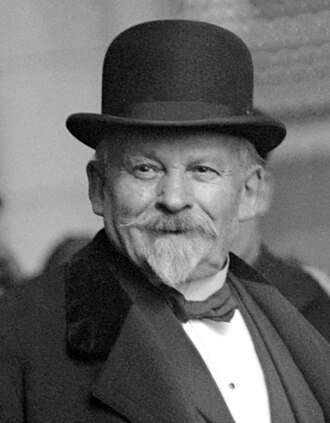
Émile Coué
1857–1926 · French psychologist, pharmacist and hypnotist who promoted optimistic autosuggestion
Émile Coué (Troyes, 1857 – Nancy, 1926) was a French pharmacist, hypnotist and psychologist who developed a popular method of psychotherapy and self-improvement based on optimistic autosuggestion. He belonged to the Nancy School, the late nineteenth-century current that studied suggestion and hypnosis, and his work sits between medicine, psychology and self-help. It matters because it shifted attention away from hypnosis as the operator's domination of the subject and toward the idea that each person can steer their own suggestions.
Coué came from a family of modest means. He first wanted to study analytical chemistry, but his father's precarious finances forced him to give up those studies. He qualified in pharmacology in 1876 and worked as an apothecary in Troyes from 1882 to 1910. There he noticed that reassuring customers and praising each remedy seemed to improve their response, an effect later known as the placebo effect. In 1886 and 1887 he studied in Nancy with Ambroise-Auguste Liébeault and Hippolyte Bernheim. In 1910 he sold his pharmacy, settled in Nancy and opened a clinic that treated large numbers of patients for more than fifteen years, many of them in groups and free of charge. In 1913 he and his wife founded the Lorraine Society of Applied Psychology. His main book, Self-Mastery Through Conscious Autosuggestion, appeared in England in 1920 and in the United States in 1922.
His central idea is that a complex arrangement of ideas, especially dominant ones, continually and spontaneously suggests things to us, and this shapes our health and wellbeing. Coué distinguished deliberate, conscious self-suggestion from spontaneous suggestion, which works without effort and in proportion to the attention we give it. Conscious willpower, he argued, could get in the way: the harder we try, the further we drift, so negative thoughts should be replaced with positive images. His phrase "Every day, in every way, I'm getting better and better" was repeated regularly and became the emblem of Couéism.
His influence was strong, especially in Europe during his lifetime and later in the United States, where writers such as Napoleon Hill and Norman Vincent Peale took up related ideas. He is now seen as a forerunner of positive psychology and much self-help literature, although his therapeutic claims have been questioned by medicine.
Key ideas
- Deliberate self-suggestion: a conscious idea we consciously direct toward a goal.
- Spontaneous suggestion: the influence of dominant ideas, which works without effort in proportion to the attention we give them.
- Imagination over willpower: forced willpower can backfire, so it is better to imagine the desired result.
- Daily formula: regular repetition of a positive phrase gradually conditions the mind.
Books to read
- Self Mastery Through Conscious Autosuggestion EnglishEPUB 133 KBRead online
Curiosities
Notes with medicines
In his Troyes pharmacy he left a small positive note with each medicine he sold.
"I have never cured anyone"
When asked whether he saw himself as a healer, he often said he had never cured anyone and only showed people how to cure themselves.
Teachers and influences
Teachers
- Ambroise-Auguste Liébeault 1823–1904
Original Filopedia text based on Wikipedia (es) and Wikipedia (en) and Wikidata.