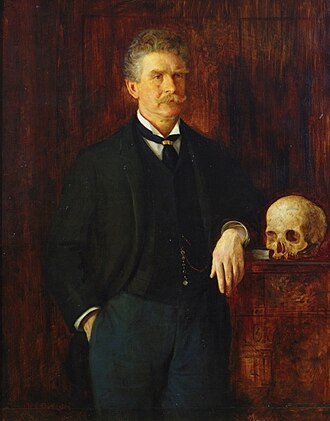
Ambrose Bierce
1842–1914 · American journalist, editor and satirical writer
Ambrose Bierce (Meigs, Ohio, 1842 – Mexico, January 1914) was an American journalist, editor and writer, best remembered for his horror and war stories and for his biting satire. He lived between the nineteenth and twentieth centuries and wrote in English. His work still engages readers because it blends dark humour with a disillusioned view of war and of human nature.
He was born in a log cabin in Ohio, the tenth of twelve children, into a family of farmers with a strict Calvinist upbringing. He grew up in Indiana and at fifteen left home to work as an apprentice at a small abolitionist newspaper. In 1859 he entered the Kentucky Military Institute, which closed the following year after a fire.
When the Civil War broke out in 1861, he enlisted in an Indiana infantry regiment. He served as a topographical officer on a general's staff and fought at Shiloh, Chickamauga and Chattanooga, and during the Atlanta campaign he was seriously wounded at Kennesaw Mountain. Those experiences shaped much of his fiction. After the war he held a brief post in the regular army and in 1866 gave up military life for good.
In San Francisco he built a reputation as a journalist and became friends with Mark Twain. Between 1872 and 1875 he lived in London, where he wrote his first satirical pieces and saw a collection of his articles published under a pseudonym. Back in California he edited magazines and joined William Randolph Hearst's San Francisco Examiner. In 1889 he moved to Washington, though his ties to Hearst's papers lasted for years.
His style relies on irony, abrupt openings, dark imagery and a bleak view of human nature. His fables and his satirical glossary, The Devil's Dictionary, attack political corruption and the social clichés of his day. Several of his stories, among them An Occurrence at Owl Creek Bridge, have become classics of horror and war writing. H. P. Lovecraft admired him, though he also faulted the uneven, journalistic quality of his prose.
His personal life was hard. He separated from his wife in 1888 and divorced in 1904, and two of his sons met tragic ends. He suffered from ill health for much of his life. In 1913 he announced that he was travelling to Mexico to see the Revolution at first hand, and then he vanished. He is believed to have died in Ojinaga in January 1914, although no definitive evidence was ever found.
His legacy lies in psychological horror, where he is regarded as an early pioneer, and in anti-war military fiction that influenced later writers. As a satirist he is placed alongside figures such as Swift, and his name still carries the nickname "Bitter Bierce" that his contemporaries gave him.
Key works
- An Occurrence at Owl Creek Bridge (short story, from the period of his most celebrated fiction)
- The Devil's Dictionary (satirical glossary, his best-known work, made of brief ironic entries)
- Tales of Soldiers and Civilians (1892; also published as In the Midst of Life, a collection of his darkest stories)
- Shapes of Clay (1903; a volume of satirical verse)
Where to start
An Occurrence at Owl Creek Bridge 1890
The Owl Creek Bridge incident is a short, accessible story full of suspense and a memorable twist ending. It recounts the execution of a civilian during the American Civil War and shows how Bierce blends realism, irony and fantasy, a core trait of his work.
Next: Tales of Soldiers and Civilians. Tales of Soldiers and Civilians expands that view of war and human nature with more stories in the same grim, ironic tone.
Works in Filopedia
Books to read
- The Damned Thing 1898, From "In the Midst of Life" EnglishEPUB 78 KBRead online
- An Occurrence at Owl Creek Bridge EnglishEPUB 85 KBRead online
- Can Such Things Be? EnglishEPUB 216 KBRead online
- The Collected Works of Ambrose Bierce, Volume 02 In the Midst of Life: Tales of Soldiers and Civilians EnglishEPUB 275 KBRead online
- Write It Right: A Little Blacklist of Literary Faults EnglishEPUB 101 KBRead online
- The Collected Works of Ambrose Bierce, Volume 01 EnglishEPUB 264 KBRead online
- Fantastic Fables EnglishEPUB 149 KBRead online
- The Cynic's Word Book EnglishEPUB 158 KBRead online
Curiosities
A price of 130 million
In 1896 a railroad executive asked him to name his price for opposing a bill that would have forgiven large federal loans to two railroad companies. Bierce replied that his price was 130 million dollars, payable to the Treasurer of the United States if he happened to be out of town. The public uproar that followed helped defeat the bill.
A book under a pseudonym
His first book, *The Fiend's Delight*, collected his articles and was published in London in 1873 under the pseudonym "Dod Grile".
Teachers and influences
Influenced
- H. L. Mencken 1880–1956
Original Filopedia text based on Wikipedia (es) and Wikipedia (en) and Wikidata.