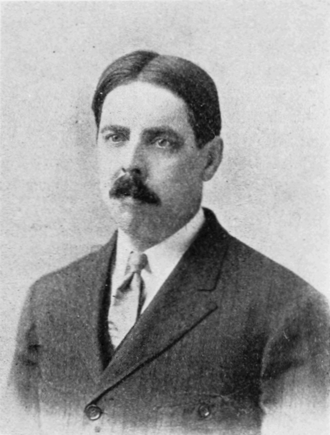
Edward Thorndike
1874–1949 · American psychologist and educator, precursor of behaviorism
Early life and family
Edward Lee Thorndike was born on 31 August 1874 in Williamsburg, into a Protestant family of the Methodist denomination. His father, Edward Roberts Thorndike, was a pastor of one of these churches, and his mother was Abbie Ladd Thorndike. He was the second of their children, and discipline and austerity marked the early years of his life at home. Two of his brothers also became scholars: Lynn, a medievalist who specialised in the history of science and magic, and Ashley, an English professor and a noted authority on Shakespeare.
Education
Thorndike was one of the first psychologists to receive his entire education in the United States. He attended the Roxbury Latin School and then Wesleyan University in Connecticut, from which he graduated in 1895. He went on to Harvard University, where William James was his teacher, and earned a master's degree in 1897. His early interest lay in communication through unconscious gestures, prompted by reports of a horse that could perform arithmetic. He then turned to animal behaviour, which would become the centre of his professional life. His first experiments with chicks were carried out in the basement of James's house, to the delight of James's children.
Experiments with animals
He completed his doctorate at Columbia University in 1898 under the supervision of James McKeen Cattell. His dissertation, "Animal Intelligence: An Experimental Study of the Associative Processes in Animals", was one of the first works in psychology in which the subjects were non-human. Thorndike was sceptical of the fables that credited animals with extraordinary intelligence. He argued that books on the subject offered more a eulogy of animals than a psychology, and that no one had bothered to describe animal stupidity. To test this he designed his well-known puzzle boxes, in which hungry cats had to escape by operating a mechanism, such as pressing a button or pulling a lever, in order to reach food. The animals moved about at random until they accidentally triggered the mechanism. With each trial they escaped more quickly, and when he plotted the times he obtained gradual learning curves. He also observed that watching other animals escape did not improve learning, and that the cats showed no sudden flashes of understanding.
The law of effect
From these experiments came his best-known contribution: the law of effect. According to it, connections between a stimulus and a response are strengthened when they are followed by a satisfying state of affairs, and weakened when followed by an annoying one. Learning therefore consisted of a series of connections "stamped in" to the nervous system through trial and error. Thorndike set out this idea as his theory of connectionism and upheld it for years. The concept provided a foundation on which B. F. Skinner later built his theory of operant conditioning. Thorndike also distinguished between the operant response, the behaviour selected from among several, and the consequence that accompanies it, which is reinforcement.
Teaching career and applications
After his doctorate, in 1899 he joined the Teachers College of Columbia University as an instructor in psychology, where he remained for the rest of his career until his retirement in 1941. There he applied the methods he had developed in animal training to the learning of children and young people, with considerable success, and became a central figure in educational psychology. He also worked on intelligence measurement and on tests for the United States Army during the First World War, and applied psychometrics to the selection and assessment of industrial personnel. He served as president of the American Psychological Association in 1912 and, in 1937, became the second president of the Psychometric Society.
Revisions to his theory
Thorndike did not stand still. In 1929 he acknowledged that he had been wrong about part of his first theory. He found that practice alone did not strengthen an association and that the passage of time alone did not weaken it, so he abandoned the law of exercise. He also revised the law of effect, concluding that a satisfying state of affairs strengthens an association but that punishment is not effective in changing behaviour. His work marks the move from functionalism to behaviourism and gave psychology a focus on the theory of learning. His ideas were later synthesised by Clark Hull together with those of Pavlov, and his influence reached Skinner, Gestalt psychology and studies of the conditioned reflex.
Controversial views
His ideas about human nature include positions that are controversial today. He supported eugenics and argued that genetic selection could alter human capacities for learning or for happiness. He also believed that differences in the behaviour of men and women had a biological rather than cultural origin, offering arguments without empirical support that justified prejudices of the period. John Watson, with whom he is often compared, openly criticised this view. These positions have been the subject of critique in the study of his work.
Legacy
Thorndike died on 9 August 1949 in Montrose. According to a study published in 2002, he ranks among the most cited psychologists of the twentieth century. His theory of learning, and in particular the law of effect, is regarded as his principal achievement. His influence extended to comparative psychology, educational psychology, measurement and pedagogical practice, and he is named as a precursor of American behaviourism.
Key ideas
- Trial and error: animals do not solve problems through sudden insight but by trying responses until one works.
- Connectionism: learning consists of connections between stimuli and responses that strengthen or weaken depending on their outcome.
- Law of effect: behaviors followed by satisfaction tend to be repeated, and those followed by discomfort tend to disappear.
- Law of exercise: practice alone is not enough to strengthen an association, an idea Thorndike abandoned after his own tests.
Books to read
Curiosities
Chicks in the cellar
His first experiments with chicks were carried out in the cellar of William James's house, to the delight of James's children.
Cats in puzzle boxes
The cats wandered and meowed until they accidentally stepped on the switch that opened the door. With repetition, they escaped faster and faster.
A calculating horse
His early interest in unconscious gestures came from reports about a horse that seemed to perform arithmetic.
Teachers and influences
Teachers
- William James 1842–1910
Influenced
- B.F. Skinner 1904–1990
Original Filopedia text based on Wikipedia (es) and Wikipedia (en) and Wikidata.