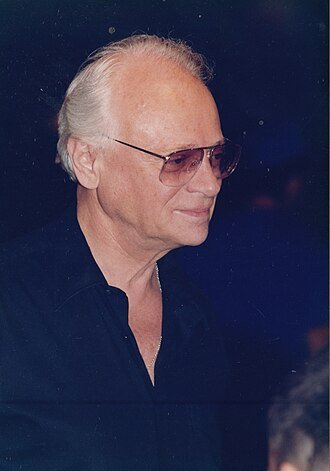
Ephraim Kishon
1924–2005 · Israeli satirist and filmmaker born in Hungary
Ephraim Kishon (born Ferenc Hoffmann in Budapest in 1924, died in Switzerland in 2005) was an Israeli satirist, writer, playwright and film director. He wrote mainly in Hebrew, but his work became hugely popular in Israel, Germany and Austria. His career shows how everyday satire helped shape the popular culture of post-war Israel.
He grew up in an assimilated Jewish family and did not learn Hebrew or Yiddish until adulthood. During the Second World War he was held in several concentration camps. By his own account, he survived partly because the commandant of one camp wanted a chess opponent. After the war he changed his surname, studied art in Hungary and published humorous articles. In 1949 he emigrated to Israel, where an official gave him the name Ephraim Kishon.
He learned Hebrew quickly, first in a transit camp and then on a kibbutz. His first success was the book Look Back, Mrs. Lot. From 1952 he wrote a satirical column, "Chad Gadya", for the newspaper Ma'ariv for about thirty years, focusing on politics and society. His humour, rooted in everyday life, affectionately portrays family routines and the struggles of immigrants. His books were translated into 37 languages.
He also wrote plays, musical numbers and screenplays, and directed films. Sallah Shabati (1964) and The Policeman (1971) were both nominated for the Academy Award for Best Foreign Language Film and won Golden Globes. He is credited with helping shape Israeli popular cinema and the comedy genre known as bourekas.
After moving to Switzerland in 1981, he grew more conservative and turned increasingly to political commentary. He received the Israel Prize in 2002. His legacy lives on in everyday Hebrew speech, in Israeli cinema and in his large German readership.
Key works
- My Family, Right and Left (1977): a comic portrait of family life in Israel and one of his most translated books.
- His Name Precedes Him (1953): a collection of his early humorous pieces about life in the new state.
- Blaumilch Canal (1969): a film he wrote and directed, a satire of bureaucracy.
Curiosities
A rival to save his life
According to his own account, the commandant of a labour camp wanted a strong chess opponent, which delayed his execution. He later recalled this as one of the few advantages of playing well.
A name given at the port
When he landed in Haifa and gave his name as Ferenc, the official told him it was not a real name and gave him the name Ephraim Kishon, taken from a nearby river.
Original Filopedia text based on Wikipedia (es) and Wikipedia (en) and Wikidata.