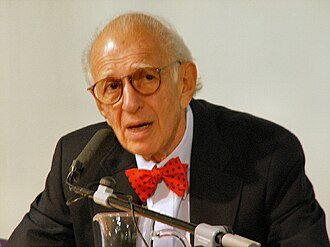
Eric Kandel
b. 1929 · Austrian-American neuroscientist and physician, 2000 Nobel laureate in Physiology or Medicine
Origins and family
Eric Richard Kandel was born in Vienna on November 7, 1929, into an assimilated Jewish family. His mother, Charlotte Zimels, had been born in 1897 in Kolomyia, then part of Austria-Hungary and today in Ukraine, and came from an Ashkenazi Jewish family. His father, Hermann Kandel, born in 1898 in Olesko, Galicia, had moved to Vienna at the start of the First World War; the two met there and married in 1923. Shortly after Eric's birth, his father opened a toy store.
Flight from Austria
Despite their thorough integration, the family sensed the Nazi danger. After Germany annexed Austria in March 1938, attacks on Jews intensified and Jewish property was confiscated. Although it came at great financial cost, the Kandels decided to leave. Eric, aged nine, and his brother Ludwig, fourteen, boarded the Gerolstein at Antwerp and arrived in Brooklyn on May 11, 1939, where they joined an uncle; their parents followed later.
Education in New York and Harvard
Once settled in Brooklyn, his grandfather tutored him in Judaic studies, and he was admitted to the Yeshiva of Flatbush, from which he graduated in 1944. He then attended Erasmus Hall High School within the New York City school system. At Harvard he majored in History and Literature and wrote an honors thesis on the attitude toward National Socialism of three German writers: Carl Zuckmayer, Hans Carossa and Ernst Jünger.
At Harvard, where psychology was dominated by B. F. Skinner, he became interested in learning and memory. The sudden death in 1951 of his favorite literature teacher, Karl Viëtor, left a deep personal loss and an unexpectedly empty schedule, which prompted a change of direction. Around then he met Anna Kris, daughter of the psychoanalysts Ernst Kris and Marianne Rie, members of Sigmund Freud's Vienna circle. Freud's ideas about unconscious neural processes shaped Kandel's interest in the biology of motivation and of conscious and unconscious memory. He switched to medicine and began his M.D. at New York University in 1952.
Early research
During medical school he grew firmly convinced that the mind had a biological basis. There he met Denise Bystryn, who would become his wife. In 1955–56 he spent six months in Harry Grundfest's laboratory at Columbia University, learning electrophysiological recording. He was drawn to Stephen Kuffler's work on neurons isolated from marine invertebrates, which were far more experimentally accessible than vertebrate brains. In 1957 he joined the Laboratory of Neurophysiology at the US National Institutes of Health. There he studied the hippocampus, in the wake of the case of patient H.M., who lost the ability to form new memories after his hippocampus was removed. Yet recordings from hippocampal neurons did not explain why that structure was so crucial for explicit memory. Kandel concluded that memory storage must depend on changes in the synaptic connections between neurons.
Choosing Aplysia
Kandel believed that comparative studies of behavior by Konrad Lorenz, Niko Tinbergen and Karl von Frisch showed that simple forms of learning existed even in very simple animals. He chose the marine mollusk Aplysia californica as his model, although many senior biologists and psychologists thought nothing useful could be learned about human memory from invertebrate physiology. After completing his psychiatry residency, he went to Paris in 1962 to work with Ladislav Tauc. There he found that habituation, sensitization and classical conditioning could be studied in ganglia isolated from Aplysia. In 1965 he published his first results, which included a form of presynaptic potentiation that appeared to correspond to a simple form of learning.
Work in New York
Kandel joined the departments of physiology and psychiatry at New York University School of Medicine, where he eventually built the Division of Neurobiology and Behavior. Working with Irving Kupferman and Harold Pinsker, he showed that the gill-withdrawal reflex, by which the animal protects its delicate gills, was sensitive to both habituation and sensitization. When Tom Carew joined, the work extended to long-term memory, and by 1981 the group had brought classical conditioning into Aplysia, helping to bridge the gap between the simple learning of invertebrates and the more complex learning of vertebrates. In 1965 he was also appointed director of the neurobiology center at Columbia University, which in 1975 became the Center for Neurobiology and Behavior.
Ideas and scientific legacy
The findings of Kandel and his colleagues showed that memory rests on changes in the effectiveness of synapses that already existed, and that the same connection can be weakened or strengthened depending on the type of learning. Memory is not confined to a single point in the circuit but is distributed across it, and the duration of short-term memory depends on how long the synaptic change lasts. Kandel tied these results to the philosophical debate between Locke, who held that all knowledge comes from learning, and Kant, who argued for innate schemas; in his view, the anatomy of the circuit reflects partly what is innate, while experience modifies the strength of its connections.
In 2000 he received the Nobel Prize in Physiology or Medicine, shared with Arvid Carlsson and Paul Greengard, for discoveries about the physiological basis of memory storage in neurons. From 1984 to 2022 he was a senior investigator at the Howard Hughes Medical Institute. His popular account of his life and research, In Search of Memory, received the 2006 Los Angeles Times Book Prize for Science and Technology.
Key ideas
- Neural plasticity: the capacity of a connection between neurons to change lastingly after experience, unlike elasticity, which returns to its original shape.
- Habituation, sensitisation and conditioning: three elementary forms of learning that change the strength of the same synapse in different directions.
- Short-term and long-term memory: short-term memory relies on temporary synaptic changes, and repetition turns them into durable memory.
- Distributed memory: memory does not reside in one fixed point but in changes spread across the neural circuit.
Curiosities
A voyage to Brooklyn
At nine, Kandel and his brother Ludwig boarded the Gerolstein at Antwerp and joined an uncle in Brooklyn on 11 May 1939.
From literature to neuroscience
The sudden death of Karl Viëtor, his favourite literature teacher, in 1951 left his next term timetable empty and pushed him towards other studies.
A sea slug to understand memory
His choice of the sea slug Aplysia was a risk, since many biologists and psychologists believed nothing useful about human memory could be learned from invertebrates.
Original Filopedia text based on Wikipedia (es) and Wikipedia (en) and Wikidata.