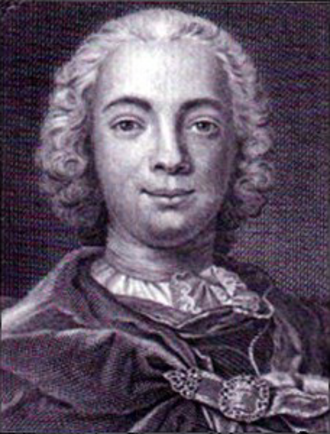
Étienne-Gabriel Morelly
1717–1778 · French utopian thinker and philosopher
Étienne-Gabriel Morelly (Vitry-le-François, 1717 – 1778 or 1782) was an eighteenth-century French writer whose work stands among the earliest origins of socialist thought. For much of the nineteenth century he was little read, and his most influential book, the Code of Nature, was at first attributed to Diderot and other philosophes. Today he is regarded as one of the first writers to place the abolition of private property at the centre of a model for a just society.
Little is documented about his life. He worked as a minor tax official and as a teacher, and he wrote books on education and a critique of Montesquieu. His first notable work was the utopian poem Shipwreck of the Floating Islands, or the Basiliad of the Famous Pilpai (1753), a satirical epic that denounces the state of human reason and the blindness of people to their true interests. Its setting, a fertile continent where no one owns anything in particular, draws on the Inca Garcilaso, Thomas More and other imaginary travel narratives. Because the poem attracted little attention, Morelly set out his ideas systematically in the Code of Nature (1755), published anonymously.
The Code has four parts. The first two criticise the usual principles of morality and politics, which he traces to the desire to possess. He argues that private property is the root of most social ills: as long as it exists, laws merely distribute unequally what the earth produces. The third part holds that property also generates moral conflict and violent passions, and that the most humane peoples have been those without established property. The fourth part sets out a detailed legal model: three fundamental laws, an economy based on need, the preservation of the family, common education and a federation of small, largely autonomous communities. Morelly acknowledged that his plan was utopian.
His influence has been considerable. His defence of abolishing property and of total equality makes him a forerunner of Babeuf, Fourier, Proudhon, Blanc and Marx, all of whom cited or discussed him. The principle of contributing according to ability and receiving according to need, which Soboul credits him with first formulating, anticipates one of the central maxims of nineteenth-century socialism. His book was controversial in its day: the Catholic Church condemned it in 1761, and it remained on the Index of Forbidden Books until 1948.
Key ideas
- Abolition of property: for Morelly, private property is the source of most vices and inequalities, and it must disappear.
- Total equality: no social distinction should remain, whether based on wealth, talent or delegated authority.
- Distribution according to need: each contributes according to ability and receives according to need.
- Federal organisation: the state would consist of small, autonomous communities, with an economy organised around cities.
- Natural morality: true morality arises from human nature rather than from the desire to possess.
Curiosities
Mistaken authorship
The Code of Nature was published anonymously, and for a time it was attributed to Diderot and other philosophes of the Enlightenment.
Ecclesiastical condemnation
The Sacred Congregation of the Index condemned the work by decree on 19 January 1761, and it stayed on the Index until 1948.
Original Filopedia text based on Wikipedia (es) and Wikipedia (en) and Wikidata.