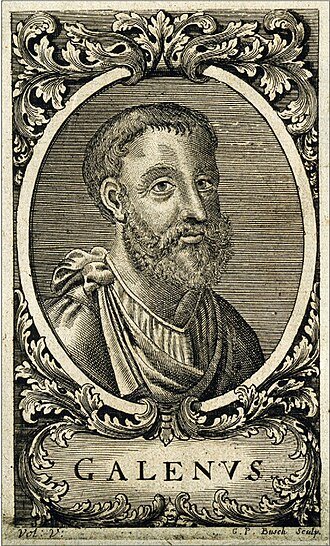
Galen
129–300 · Greek physician, surgeon and philosopher of the Roman Empire
Origins and training
Claudius Galenus, known in later tradition as Galen, was born in Pergamon, in what is now Bergama in Turkey, in 129 CE, into a wealthy family. His father, Aelius Nicon, was an architect and landowner with wide intellectual interests that included philosophy, mathematics, logic, astronomy, agriculture and literature. He took care to give his son a thorough education with Stoic and Platonic influences, perhaps intending a career in philosophy or politics.
Pergamon was then a major cultural centre, with a library second only to Alexandria's and a famous sanctuary dedicated to Asclepius, the god of healing. Galen later reported that his father dreamed the god instructed him to send the boy to study medicine. Around the age of sixteen Galen entered the local asclepeion as a therapeutes, an attendant, and spent four years there under local physicians. These sanctuaries functioned partly as spas and care centres, and patients from many backgrounds, Romans included, came to them.
His father died in 148, leaving Galen a considerable fortune that allowed him to travel. Following the advice he found in the teaching of Hippocrates, he visited Smyrna, Corinth, Crete, Cilicia, Cyprus and finally Alexandria, where he encountered the competing medical schools of the day: the Empiricists, the Rationalists and the Methodists.
Pergamon and the gladiator school
In 157, at the age of twenty-eight, he returned to Pergamon as physician to the gladiators of the High Priest of Asia, one of the most powerful and wealthy men in the province. Galen recounts that he won the post over other physicians after dissecting an ape and challenging his colleagues to repair the damage, which none of them would attempt. Over about four years he learned the importance of diet, fitness, hygiene and prevention, as well as living anatomy and the treatment of fractures and severe trauma. He called wounds "windows into the body". According to the accounts, only five gladiators died during his tenure, compared with sixty under his predecessor, a result generally credited to his careful attention to their injuries.
Rome and the imperial court
In 162 he moved to Rome, where he quickly built a reputation as a practising physician. His public demonstrations and his impatience with rival views brought him into conflict with other doctors in the city. When his teacher, the Peripatetic philosopher Eudemus, fell ill with quartan fever, Galen treated him, writing that the other physicians had given him up. His critics objected to his use of prognosis, a method that clashed with a traditional practice relying on divination and mysticism. Galen answered that diagnosis requires observation and reasoning. Eudemus warned him that such quarrels could end in poisoning, and Galen, fearing for his life, left the city.
He returned after the great epidemic of about 166 to 169, the Antonine Plague, probably smallpox, which he described in detail and which took its name from the imperial dynasty. He was summoned to the court of Marcus Aurelius and Lucius Verus, who were campaigning against the Marcomanni in the north. The emperor later allowed him to return to Rome but kept him on as physician to his heir, Commodus. Galen remained attached to the court for much of the following reigns and also attended Septimius Severus and Caracalla. He thus witnessed decisive events: the plague, the Marcomannic Wars, the murder of Commodus, the civil war and the rise of Septimius Severus.
Works and method
Galen wrote in Greek, a language that carried more prestige than Latin in the medicine of his time. He is credited with more than four hundred texts, of which around one hundred and fifty survive, largely through later translations. By his own account he employed numerous scribes to take down his dictation. A fire in the Temple of Peace in 191 or 192 destroyed many of his writings, especially his philosophical works. His principal work, the Methodus medendi, on the art of healing, exerted enormous influence for centuries.
His thought rests on the Hippocratic tradition, to which he added elements from Plato and Aristotle, transmitted through the Stoicism of Posidonius. His method combined direct observation, dissection and vivisection, occupying a middle ground between the Rationalists and the Empiricists. For this reason he is regarded as one of the earliest experimentalists in medicine.
His physiology distinguished three kinds of pneuma, or spirit: the natural, seated in the liver, which governed nutrition and growth; the vital, in the heart, responsible for breathing and the pulse; and the animal, in the brain, the basis of sensation, movement and mental faculties. His doctrine of the humours, combined with Hippocratic ideas, produced a typology of temperaments that lasted for centuries.
He could not dissect human bodies, which Roman law had forbidden for a long time, so he worked on animals, chiefly apes and pigs. Extending animal anatomy to humans led him into notable errors, such as his description of the uterus or the course of the blood. He believed blood was made in the liver and passed to the heart through pores in the septum, and that arteries carried blood rather than air, correcting Erasistratus and Herophilus on this point. By cutting the recurrent laryngeal nerves of animals he showed that the voice depends on the brain, and he studied the functions of the kidneys, the bladder and the spinal cord. He described seven pairs of cranial nerves, the valves of the heart, and structural differences between veins and arteries.
Reception and legacy
Galen's influence was extraordinary. In late antiquity Galenism became almost the only framework of medicine, so much so that it was said Hippocrates had sown and Galen had reaped. In the Byzantine Empire his works were continually copied and studied. After the Arab conquest of Syria, Christian and Muslim translators rendered them into Syriac and Arabic, and physicians such as al-Razi, Avicenna and Ibn al-Nafis discussed, corrected and extended them. In the thirteenth century Ibn al-Nafis described the pulmonary circulation, contradicting Galen on the heart.
In the Latin Middle Ages his anatomical and medical texts formed the core of the university curriculum, alongside Avicenna's Canon, and he was called the "medical pope of the Middle Ages". From the eleventh century onward translations reached the West, and in the Renaissance his complete works in Latin were printed at Venice in 1490. Paracelsus publicly burned the writings of Avicenna and Galen at Basel, a symbol of the rejection of authority.
The decisive challenge to his authority came from Andreas Vesalius, who in the sixteenth century translated many of his Greek texts but, by dissecting human cadavers, showed that many Galenic descriptions applied to monkeys rather than people. His De humani corporis fabrica (1543) drew on Galen's method of direct observation while correcting his conclusions. Even so, his model of medicine grounded in theory, observation and experiment remains one of the foundations of Western medical science.
Key ideas
- Spirits as a subtle form of matter: the body moves through spirits, a very fine kind of matter that sets the organs in motion.
- The powers of the organs: each organ has its own force, such as the kidney's capacity to draw in blood and expel urine, and these forces are activated by the spirits.
- Observation as method: medical theory had to be tested through animal dissection, vivisection and clinical experience.
- Medicine and philosophy together: for Galen the good physician should also be a philosopher, able to reason about the causes of disease.
Books to read
- Galen: On the Natural Faculties EnglishGutenberg
Curiosities
Wounds as windows
Galen described wounds as 'windows into the body', a phrase that reflects how much he learned from treating the gladiators of Pergamon.
Pigs instead of monkeys
According to the account associated with him, Galen found that Barbary apes had very expressive faces and switched to pigs for his research to avoid prosecution.
An army of scribes
By his own testimony, he used twenty scribes to take down his words, a sign of how vast his output was.
Teachers and influences
Influenced
- Avicenna 980–1037
- Andreas Vesalius 1515–1564
- Georges Canguilhem 1904–1995
Original Filopedia text based on Wikipedia (es) and Wikipedia (en) and Wikidata.