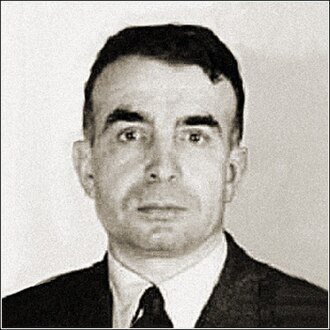
Georges Canguilhem
1904–1995 · French philosopher and physician, historian of science
Georges Canguilhem (Castelnaudary, 1904 – Marly-le-Roi, 1995) was a French philosopher and physician who worked on epistemology and the history of science, above all the philosophy of biology. He belonged to the French tradition of historical epistemology, which asks how scientific concepts are formed and transformed over time. His medical training shaped his approach to philosophy in a distinctive way.
He entered the École Normale Supérieure in 1924, in a class that included Jean-Paul Sartre, Raymond Aron and Paul Nizan. After passing the agrégation in philosophy in 1927, he taught in schools across France, and while teaching in Toulouse he began studying medicine. During the Second World War he worked as a doctor in Auvergne and took part in the French Resistance under the pseudonym "Lafont". He received his medical doctorate in 1943. In 1955 he became a professor at the Sorbonne and succeeded Gaston Bachelard as director of the Institute for the History of Science, a post he held until 1971.
His best-known book, The Normal and the Pathological, examines what normality means in medicine and biology and how medical knowledge is produced and institutionalised. In The Formation of the Concept of Reflex he traced the history of a single scientific notion, and in The Knowledge of Life he addressed the specificity of biology, the history of vitalism and the idea that an organism cannot be reduced to a machine, since it is defined by its relation to its environment and by a complexity greater than the sum of its parts. He later nuanced this critique of mechanism in Ideology and Rationality in the History of the Life Sciences.
As an inspector general and president of the philosophy agrégation jury, he exerted a strong influence on philosophy teaching in France. His thought shaped Michel Foucault, and he also mentored several intellectuals of the 1960s and 1970s. His legacy endures in the history of the life sciences and in medical anthropology.
Key ideas
- Normativity: norms that seem natural are largely the product of a prior regulating power.
- The specificity of biology: a living organism cannot be fully explained as a machine, since its functioning depends on its relation to its environment.
- The normal and the pathological: health and disease are not purely objective categories, but depend on the norms each organism sets within its milieu.
- Critical history of concepts: scientific concepts, such as reflex, must be studied in the historical process of their formation.
Curiosities
Resistance under a pseudonym
During the war he worked as a doctor in Auvergne and took part in the French Resistance under the pseudonym "Lafont".
Althusser's remark
Louis Althusser remarked that Canguilhem believed he could correct teachers' philosophical understanding by bawling them out.
Teachers and influences
Teachers
- Alain 1868–1951
Pupils
- Michel Foucault 1926–1984
- Gilles Deleuze 1925–1995
- Étienne Balibar b. 1942
Influenced by
- Aristotle 383 BC–321 BC
- Karl Marx 1818–1883
- Friedrich Nietzsche 1844–1900
- Immanuel Kant 1724–1804
- René Descartes 1596–1650
- Henri Bergson 1859–1941
- Galen 129–300
- Auguste Comte 1798–1857
- Georges-Louis Leclerc, Comte de Buffon 1707–1788
- Gaston Bachelard 1884–1962
- Alain 1868–1951
- Kurt Goldstein 1878–1965
Influenced
- Michel Foucault 1926–1984
- Gilles Deleuze 1925–1995
- Pierre Bourdieu 1930–2002
- Louis Althusser 1918–1990
Original Filopedia text based on Wikipedia (es) and Wikipedia (en) and Wikidata.