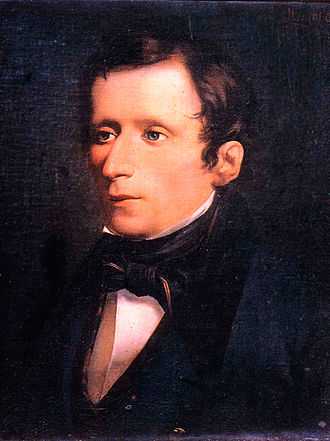
Giacomo Leopardi
1798–1837 · Italian Romantic poet, philosopher and philologist
Giacomo Leopardi (Recanati, 1798 - Naples, 1837) was an Italian poet, philosopher and philologist, one of the central figures of nineteenth-century Italian literature and one of the most lucid thinkers of modern pessimism. He is usually placed within Romanticism, although he held views of his own, often opposed to those of his fellow Romantics. He matters because he combined enormous erudition with a hard and honest reflection on human suffering and on nature.
He was born in the family palazzo in Recanati, a small town in the Papal States. His father, Count Monaldo, was a reactionary scholar who had squandered much of the family fortune but had built up a remarkable library. His mother, Adelaide Antici, was a stern and rigid woman, determined to restore the family's standing through a strict regime of discipline. From childhood Giacomo suffered a serious spinal illness that bent his back and left him frail for life. This fragile health, combined with immense study in his father's library, shaped his youth. At eleven he was reading Homer; by fifteen he had written two tragedies and an essay on Porphyry, and he knew seven languages. His education was largely self-directed, since his religious tutors admitted they had little more to teach him. Around 1810 he received the tonsure, but his reading of the French Encyclopedists ended his religious faith.
Around 1817 he began a correspondence with the humanist Pietro Giordani, who became his friend and publisher. Life in Recanati grew unbearable. In 1818 he tried to escape, but his father intercepted his letters to the liberal patriot Montani and the attempt failed. From then on his life became a cycle of departures and returns between Rome, Bologna, Milan, Florence and Pisa. In Rome, in 1822, he was disappointed by the city's corruption and by what he saw as the hypocrisy of the Church. In 1828 he turned down a professorship at the University of Bonn. In Florence he met Antonio Ranieri, a loyal friend who later took him in at Naples. He earned a living through private tutoring and editorial work, and his loves were nearly always out of reach, including his passion for Fanny Targioni-Tozzetti, whom he celebrated under the name Aspasia.
His philosophical prose appears in the Operette morali (1827), essays many of them written as dialogues, and in the Zibaldone, a notebook he kept until 1832. His poetry was collected in the Canti, whose first edition appeared in Florence in 1831 and a second in Naples in 1835. A posthumous edition of 1845 added La ginestra. His verse combines a carefully controlled neoclassical form with Romantic content. It falls into three broad phases: an early, more classical stage; a central group of intense poems that are often considered his finest; and a late stage of reflective poetry.
His thought starts from an uncompromising pessimism. Leopardi saw nature as a relentless force that drives living beings toward suffering with no purpose. Against it he found three consolations: devotion to heroes and a glorious past, the memory of youthful illusions, and the contemplation of a misty, moonlit landscape. He rejected the false comforts of progress, yet he felt a deep pity for human frailty, and from that pity grew his call for solidarity. In «The Infinite» and in «To Himself» he gave voice to anguish before a silent universe with a calm dignity. Late in life he softened this pessimism in «Palinode», though he closed that poem with irony.
He died in Naples in 1837 during the cholera epidemic, probably from pulmonary oedema or heart failure. According to tradition, Ranieri intervened to prevent a burial in a common grave and paid for a tomb, although accounts of those arrangements are disputed. His influence grew over time. Unamuno translated «La retama» and drew on Leopardi's image of nature as «a mother in childbirth, a stepmother in her wish» in his Del sentimiento trágico de la vida. Today he is regarded as the greatest lyric poet of nineteenth-century Italy.
Key ideas
- Cosmic pessimism: human existence is marked by suffering, and nature shows no concern for the wellbeing of those who live within it.
- Relentless nature: he first saw nature as a consolation for people and later as a destructive mechanism.
- Pity and solidarity: faced with shared suffering, compassion for others is the only dignified response.
- Critique of progress: he regarded the optimism of progress as a false comfort that hid the human condition.
Books to read
Curiosities
Early reading
At eleven he was already reading Homer, and by fifteen he had written an essay on Porphyry and mastered seven languages.
Deceptive Greek poems
He composed two poems in ancient Greek that managed to fool some Hellenists of his day.
A declined professorship
In 1828 he turned down a professorship at the University of Bonn, despite his precarious financial and physical situation.
Teachers and influences
Influenced
- Friedrich Nietzsche 1844–1900
Original Filopedia text based on Wikipedia (es) and Wikipedia (en) and Wikidata.