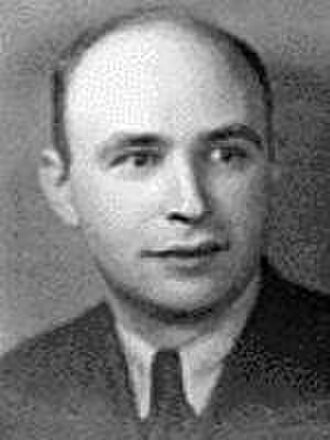
Gustav Bergmann
1906–1987 · Austrian-American philosopher of the Vienna Circle and logical positivism
Gustav Bergmann (Vienna, 1906 – Iowa City, 1987) was an Austrian-American philosopher associated with the Vienna Circle, the group that promoted a scientific worldview under the name of logical positivism. His career links the central European analytic tradition with the American academy, and it helps explain how neopositivist ideas reached the English-speaking world.
He studied mathematics at the University of Vienna, where he earned his doctorate in 1928 with a dissertation on differential geometry supervised by Walther Mayer. While still a doctoral student he was invited to join the Vienna Circle, and in 1930–31 he worked with Albert Einstein in Berlin. As a Jew he could not find an academic post in Austria, so he took a law degree and practised corporate law until he fled with his family to the United States in 1938. From 1939 he taught at the University of Iowa, where he eventually became professor of both philosophy and psychology.
His work belongs to the tradition of logical analysis of language, shaped by Wittgenstein and Russell, though he departed from the strict physicalism of some Circle members. He is chiefly linked to nominalism and to the effort to reconstruct ontology rigorously through the analysis of language.
His influence is felt mainly in American analytic philosophy, where he helped carry the legacy of logical positivism after the emigration of European thinkers.
Key ideas
- Logical analysis: philosophy clarifies problems by examining the logical structure of language.
- Nominalism: only concrete individuals exist, and properties and relations must be understood without positing independent abstract entities.
- Critique of strict physicalism: statements about experience and the world require more nuance than a simple physicalism allows.
- Rigorous ontology: questions about what exists are answered through the logical reconstruction of statements, not through intuition.
Curiosities
From mathematics doctorate to corporate law
He earned his mathematics doctorate in 1928, but unable to find an academic post as a Jew, he also took a law degree and practised corporate law.
Working with Einstein
In 1930–31 he worked with Albert Einstein in Berlin.
Teachers and influences
Influenced by
- Bertrand Russell 1872–1970
- Ludwig Wittgenstein 1889–1951
- G. E. Moore 1873–1958
Original Filopedia text based on Wikipedia (en) and Wikidata.