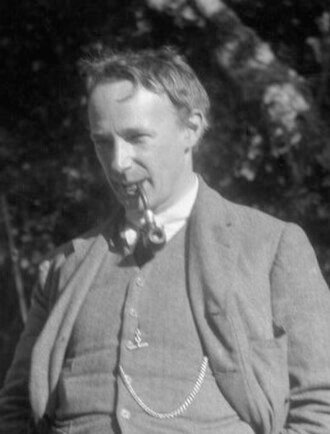
G. E. Moore
1873–1958 · British philosopher, founding figure of analytic philosophy
George Edward Moore (Upper Norwood, London, 1873 – Cambridge, 1958) was a British philosopher and professor at the University of Cambridge. Together with Bertrand Russell, Ludwig Wittgenstein and, earlier, Gottlob Frege, he is counted among the founders of analytic philosophy. He and Russell turned away from the idealism that then dominated British philosophy and defended common-sense positions, contributing to ethics, epistemology and metaphysics. He signed his work "G. E. Moore" because he disliked his first name.
The son of a doctor, he studied at Trinity College, Cambridge, first classics and then moral sciences, encouraged by Russell. There he worked under Henry Sidgwick and John McTaggart, whose ideas he reworked in his early ethical writing. He was elected a fellow of Trinity in 1898, and in 1903 he published Principia Ethica, the book that made his reputation. When his fellowship expired in 1904 he lived for some years on family money in Edinburgh, until Trinity offered him a permanent post in 1911 and he returned to Cambridge. He became a Fellow of the British Academy in 1918, edited the journal Mind from 1921 to 1947, and held the chair of mental philosophy and logic from 1925 until he retired in 1939, remaining active at Trinity until his death.
His approach rested on a simple demand: philosophy should be clear, and should advance by analysing concepts. In ethics he held that good is a simple, indefinable quality, recognised by intuition and not reducible to natural properties. This led to his open-question argument and his charge of the naturalistic fallacy against theories that tried to define the good in terms of pleasure, utility or any other natural feature. In epistemology he defended common sense against scepticism: in A Defence of Common Sense (1925) he argued that some basic beliefs, such as those about physical objects and other people, are certainly true, and in Proof of an External World (1939) he illustrated the point by raising his hands. His essays, above all The Refutation of Idealism, helped shape modern philosophical realism.
He was widely admired by philosophers of his time and by members of the Bloomsbury Group. Outside academic philosophy, however, he is now little known. He is regarded as one of the pioneers of conceptual analysis and of the linguistic emphasis in contemporary philosophy, and his defence of ethical non-naturalism remains a central reference in metaethics.
Key ideas
- Conceptual analysis: the task of philosophy is to clarify problematic concepts by restating them in clearer, equivalent terms.
- Indefinable good: goodness is a simple quality that cannot be defined in terms of other properties; it can only be recognised, as yellow is.
- Naturalistic fallacy: identifying good with a natural property, such as pleasure, confuses a moral question with an empirical one.
- Common sense: some basic beliefs about the external world are true and need no sceptical justification.
- Moral intuition: basic ethical principles are known through self-evident intuition, not through proof or experiment.
Works in Filopedia
- Principia Ethica 1903
Books to read
Curiosities
A name he avoided
Moore disliked his first name, George Edward, and never used it; he signed his articles with the initials "G. E.".
The raised hand
In A Proof of the External World he held that the existence of the external world is demonstrated by raising one's hands, an image that became his best-known.
An enthusiastic admirer
Bertrand Russell, then 22 and a fellow member of the Cambridge Apostles, wrote that he almost worshipped Moore as a god.
Teachers and influences
Influenced
- Bertrand Russell 1872–1970
- Georg Henrik von Wright 1916–2003
- Mary Midgley 1919–2018
- Samuel Alexander 1859–1938
- C. D. Broad 1887–1971
- Gustav Bergmann 1906–1987
Original Filopedia text based on Wikipedia (es) and Wikipedia (en) and Wikidata.