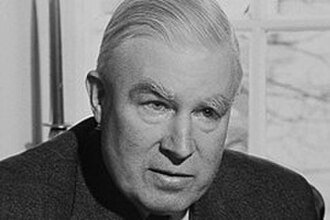
Georg Henrik von Wright
1916–2003 · Finnish philosopher, pioneer of deontic logic
Georg Henrik von Wright (Helsinki, 1916–2003) was a Finnish philosopher who wrote in Swedish, his mother tongue, and also in English, German and Finnish. He is considered the founder of contemporary deontic logic, the formal study of obligation, permission and prohibition. Trained in logical empiricism, he worked across philosophical logic, the philosophy of action, of language and of mind, and became the leading figure in Finnish philosophy of his generation.
At the University of Helsinki he studied under Eino Kaila, a member of the Vienna Circle who introduced him to logical empiricism. After a stay at Trinity College, Cambridge, where he met G. E. Moore and Ludwig Wittgenstein, he defended a doctoral thesis on the logical problem of induction in 1941. He returned to Cambridge in 1947 and succeeded Wittgenstein as professor in 1948, a post he held until 1951. That year he published his Treatise on Induction and Probability and the essay "Deontic Logic", which helped launch modern deontic logic and, with his modal logic essay, the postwar revival of formal modal logic.
Much of his later work concerned action and norms, in books such as Norm and Action and The Varieties of Goodness, the latter drawn from Gifford Lectures he regarded as his best work. As an editor of Wittgenstein, he helped prepare several posthumous texts, including the notebooks of 1914–1916 and On Certainty.
In his last decades, influenced by Oswald Spengler, Jürgen Habermas and the Frankfurt School, he took a pessimistic view of modern civilisation. In The Myth of Progress he questioned whether material and technological advance deserves to be called progress in any human sense.
His influence reaches formal logic, Finnish analytic philosophy and the study of action and norms, and can be seen in students such as Jaakko Hintikka.
Key ideas
- Deontic logic: a formal system analysing obligation, prohibition and permission, treated in parallel with the modes of modal logic.
- Logic of induction and probability: an inquiry into how inferences from observed cases to general claims can be justified, with probability as its central tool.
- Philosophy of action: an analysis of the relation between norms, intentions and human action, developed mainly in Norm and Action.
- Moral pessimism: the view that material and technological progress does not by itself guarantee progress in the human and moral sphere.
Curiosities
Scottish ancestry
He descended from a seventeenth-century Scottish family that was raised to the Finnish nobility in 1772.
Wittgenstein's successor
When Wittgenstein retired from his Cambridge chair in 1947, von Wright succeeded him the following year.
Teachers and influences
Teachers
- Eino Kaila 1890–1958
Pupils
- Jaakko Hintikka 1929–2015
Influenced by
- Aristotle 383 BC–321 BC
- Ludwig Wittgenstein 1889–1951
- G. E. Moore 1873–1958
- Eino Kaila 1890–1958
Original Filopedia text based on Wikipedia (es) and Wikipedia (en) and Wikidata.