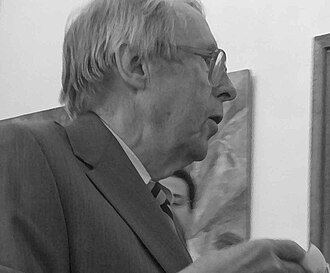
Jaakko Hintikka
1929–2015 · Finnish philosopher and logician
Jaakko Hintikka (Vantaa, 1929 – Porvoo, 2015) was a Finnish-American philosopher and logician, and one of the most influential figures in twentieth-century logic. He is considered the founder of formal epistemic logic and of game semantics for logic. He studied at the University of Helsinki under Georg Henrik von Wright and earned his doctorate in 1953 with a thesis on predicate logic. After a stint as a Junior Fellow at Harvard, he taught at Helsinki, Stanford and Florida State University before joining Boston University in 1990, where he remained until his death.
His output was vast, with more than thirty books and over three hundred articles across mathematical logic, philosophical logic, the philosophy of mathematics, epistemology, the theory of language and the philosophy of science. From 1965 to 2002 he was chief editor of the journal Synthese.
Early in his career he built a semantics for modal logic that closely resembled the one Saul Kripke would propose, and he arrived independently at the semantic tableau, now a standard teaching method, without yet knowing the work of Evert Willem Beth, who had reached the same idea separately. Later he concentrated on game semantics and on independence-friendly logic, whose "branching quantifiers" he thought matched our intuitions about quantifiers better than conventional first-order logic. He also wrote important studies of Aristotle, Kant, Wittgenstein and Charles S. Peirce.
He is placed within the analytic tradition of Anglo-American philosophy, which he saw as running from Frege and Russell through Quine and his teacher von Wright. His influence is most visible in epistemic logic, in the use of games to explain meaning and truth, and in the history of logic. His 2005 Rolf Schock Prize recognised his logical analysis of modal concepts such as knowledge and belief.
Key ideas
- Epistemic logic: the formal treatment of knowledge and belief through modal operators, which gave rise to a field of its own.
- Game semantics: the reading of logical formulas as games between a verifier and a falsifier, in which truth amounts to winning.
- Branching quantifiers: an extension of first-order logic in which dependencies between variables are set up more flexibly than in the conventional system.
- Semantic tableau: a proof method that tests validity by systematically searching for counterexamples.
Teachers and influences
Teachers
- Georg Henrik von Wright 1916–2003
- Eino Kaila 1890–1958
Original Filopedia text based on Wikipedia (es) and Wikipedia (en) and Wikidata.