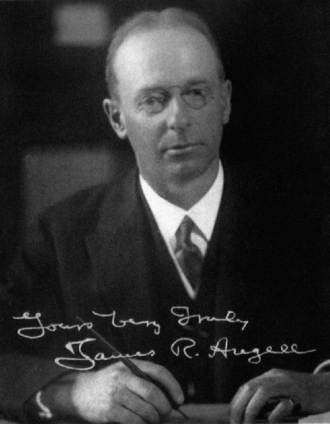
James Rowland Angell
1869–1949 · American psychologist and educator, co-founder of functionalism
James Rowland Angell (1869-1949) was an American psychologist and educator and one of the founders of the functionalist school. He was trained at the universities of Michigan and Harvard at a time when psychology was seeking to establish itself as a science separate from philosophy.
Angell studied with John Dewey at Michigan and then continued his training at Harvard and in Germany, though he never completed a doctorate. In 1905 he led the newly created psychology department at the University of Chicago, and in 1906 he presided over the American Psychological Association. His textbook Psychology (1904) became the most influential statement of the approach. He later left research for administrative posts and, from 1921 to 1937, served as president of Yale University.
For Angell, consciousness was not a sum of elements, as Titchener's structuralism proposed, but something to understand through its function: it appears when reflexes, instincts and habits fail to solve a problem of adaptation. Mind and body formed a single unit shaped by evolution, and psychology belonged among the biological sciences.
His influence can be seen in the opening of psychology to psychological tests, animal behaviour research and the experimental method. Among his students was John B. Watson, who later founded behaviorism.
Key ideas
- Functionalism: psychology studies mental operations for their role in helping the organism adjust to its environment, rather than the elements of consciousness.
- Adaptive consciousness: consciousness arises when habits and instincts are not enough to solve a problem, and through repetition conscious acts can become automatic.
- Unity of mind and body: mind and body cannot be separated and work together in the struggle to survive.
- Biological psychology: psychology belongs within evolutionary science and combines introspection with objective methods.
Curiosities
No doctorate
Although he studied in Germany, he never received a doctorate, because he left his dissertation unfinished after accepting a post at Michigan.
Acting president at Chicago
In 1918 he served as acting president of the University of Chicago, but he was not appointed permanently because he was not Baptist.
Teachers and influences
Influenced by
- John Dewey 1859–1952
Original Filopedia text based on Wikipedia (es) and Wikipedia (en) and Wikidata.