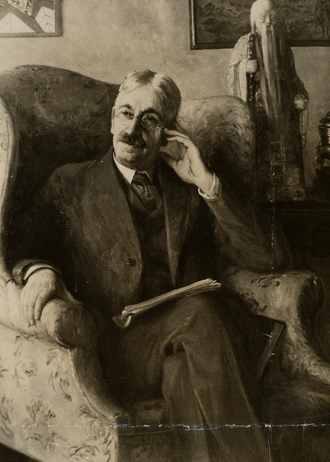
John Dewey
1859–1952 · American pragmatist philosopher, psychologist and educational reformer
Origins and training
John Dewey was born in Burlington, Vermont, on October 20, 1859, into a family of modest means. He was the son of Archibald Sprague Dewey and Lucina Artemisia Rich Dewey, and was born forty weeks after the death of an older brother who was also named John. He studied at the University of Vermont, graduating in 1879, and after brief spells as a schoolteacher in Oil City, Pennsylvania, and in Charlotte, Vermont, concluded that primary and secondary teaching was not his immediate vocation.
He continued his training at Johns Hopkins University, one of the first institutions to organize university study on the German model. There he worked with George Sylvester Morris, a neo-Hegelian idealist, and came into contact with Charles Sanders Peirce, Herbert Baxter Adams and G. Stanley Hall. From this Hegelian atmosphere he took a taste for logical systematization, an interest in social and psychological questions, and the idea of a common root for the objective and the subjective. He received his doctorate in 1884 with a dissertation, now lost, on Kant's psychology written from an idealist standpoint.
Early academic years at Michigan
That same year he joined the University of Michigan at Morris's invitation, remaining there in two periods (1884–1888 and 1889–1894). It was at Michigan that he published his first books, Psychology (1887) and a study of Leibniz's New Essays (1888), which expressed his early commitment to British neo-Hegelianism. His aim was to synthesize idealism and experimental science.
At Michigan he also met Alice Chipman, whom he married in 1886. Alice, who had been his student, became a decisive collaborator and the person who did most to turn his attention towards educational questions. They had six children, one of whom died in childhood. Alice died in 1927, weakened by malaria contracted on a trip to Turkey and by a heart attack suffered in Mexico. In 1946, now a widower, Dewey married Roberta Lowitz Grant, and the couple adopted two children.
The University of Chicago and functional psychology
In 1894 he moved to the newly founded University of Chicago, where he stayed until 1904. There he gathered a group of young psychologists, among them James Hayden Tufts, George Herbert Mead and James Rowland Angell, with whom he advanced what became known as the Chicago school. Their approach, later called functional psychology, placed the activity of mind within its social environment and practical action, in contrast to the physiological psychology of Wilhelm Wundt and his followers.
The most cited text of this period is "The Reflex Arc Concept in Psychology" (1896), in which he criticized the traditional view of stimulus and response as separate events linked in a chain. For Dewey, stimulus and response form a unitary circuit, and what counts as one or the other depends on how the situation is considered. The essay is regarded as a starting point of functionalist psychology. In 1899 he was elected president of the American Psychological Association.
In Chicago he also founded the University's Laboratory Schools, where he could put his pedagogical ideas into practice. From that project came his first major book on education, The School and Society (1899). Disagreements with the university administration eventually led to his departure.
Pedagogy and Teachers College
From 1904 until his retirement in 1930 he was professor of philosophy at Teachers College, Columbia University, in New York, and there he became the most influential figure of American progressive education, shaping the thinking of three generations. His best-known pedagogical work is Democracy and Education (1916), in which he argues that education is a social and interactive process, that the school is itself a social institution capable of bringing about reform, and that pupils should take part in their own learning.
Dewey rejected education understood as the mere transmission of content from expert to learner. He held instead that children learn by doing, and that teachers should design experiences and projects in which students investigate real problems. This idea of learning by doing, together with his account of reflective thought set out in How We Think, makes him one of the foundations of active pedagogy. He also criticized those who, in the name of child-centredness, minimized the role of subject matter and of the teacher.
Pragmatism, experience and democracy
Dewey was, together with Charles Sanders Peirce and William James, one of the founders of pragmatism. His theory of knowledge revolved around the concept of experience, understood as the continuous interaction between a living organism and its environment. Concepts and beliefs are provisional human constructions that must be tested in action, so that philosophy's task is to reconstruct inherited moral and social practices and beliefs.
In political matters, his central conviction was that democracy is more than a form of government: it is a way of life and an ethical ideal consisting in the development of personality and in the participation of all in forming shared values. He set out this thesis clearly in The Public and Its Problems (1927), written in reply to Walter Lippmann, who regarded the public as incapable of thought and action. For Dewey, democracy requires an informed public opinion, which demands effective communication among citizens, experts and politicians, and governments fully accountable to the citizenry.
His liberalism, close to the New Liberalism of Thomas Hill Green and Leonard Trelawny Hobhouse, departed from classical individualism: freedom is not merely the absence of restraint but participation in social and political life. Dewey criticized Soviet state collectivism and the New Deal in the same measure as he rejected laissez-faire, and he defended a form of socialism that would not be state-run. He also recommended that public schools should not offer religious instruction, which he saw as a source of division in a plural society.
Aesthetics, logic and public commitments
His major work on aesthetics, Art as Experience (1934), holds that works of art are embedded in the experience of a local culture and cannot be separated from it. He also wrote on logic, notably in Logic: The Theory of Inquiry (1938), where he proposes understanding knowledge as an inquiry aimed at resolving concrete problems, and on ethics, religion and social theory.
Dewey was an intellectual of active commitment. He supported women's equality, including the right to vote; took part in founding the New School for Social Research (1919); promoted teacher unionism; and in 1929 co-founded the League for Independent Political Action. He also encouraged assistance to intellectuals exiled from totalitarian regimes.
Travels and international influence
In 1919 he travelled to Japan and then to China, where he stayed for two years and gave nearly two hundred lectures to large audiences, interpreted by his former student Hu Shih. Dewey argued that China's transformation should rest on education and social reform rather than revolution. His ideas influenced the New Education and New Culture movements, though in Maoist China they were systematically denounced. In 1934 he also visited South Africa, lecturing in Cape Town and Johannesburg.
He died of pneumonia at his home in New York on June 1, 1952, at the age of 92.
Reception and legacy
Dewey is regarded as the most important American philosopher of the first half of the twentieth century. His legacy remains debated. Supporters praise his defence of critical thinking, the democratization of the classroom and practical learning over rote memorization. Critics, from academic circles and traditional education, argue that his model diminished the transmission of fundamental knowledge and curricular rigour, weakening the American school system over the century. Whatever the verdict, his influence endures in contemporary pedagogy, in pragmatist philosophy and in the reflection on democracy.
Key ideas
- Experience: a continuous interaction between a living being and its environment, from which ideas arise as tools for solving problems.
- Instrumentalism: ideas and theories are judged by their usefulness for acting and testing consequences, not as fixed truths.
- Education as reconstruction of experience: learning means facing real problems and reorganising what we know in light of them.
- Democracy as a way of life: democracy requires education, participation and an informed public, not just the vote.
Where to start
The School and Society collects three short lectures delivered in 1899 on the relationship between school, social life and work. It is the ideal entry point because it presents Dewey's view of the school as an active community tied to real life, in clear and accessible language that requires no specialized background.
Next: Democracy and Education. Democracy and Education systematically develops the ideas sketched in those lectures and places them within the framework of democracy and the philosophy of education.
Works in Filopedia
Books to read
- How We Think EnglishGutenberg
- Democracy and Education: An Introduction to the Philosophy of Education EnglishGutenberg
- Human Nature and Conduct: An introduction to social psychology EnglishGutenberg
- Leibniz's New Essays Concerning the Human Understanding: A Critical Exposition EnglishGutenberg
- The School and Society Being three lectures EnglishGutenberg
- The public and its problems EnglishGutenberg
- Moral Principles in Education EnglishGutenberg
- Reconstruction in Philosophy EnglishGutenberg
- The Child and the Curriculum EnglishGutenberg
- Essays in Experimental Logic EnglishGutenberg
- Ethics EnglishGutenberg
- Schools of to-morrow EnglishGutenberg
- Creative Intelligence: Essays in the Pragmatic Attitude EnglishGutenberg
- The Influence of Darwin on Philosophy, and other essays in contemporary thought EnglishGutenberg
- Psychology and Social Practice EnglishGutenberg
Curiosities
A repeated name
His first son, also named John, died in an accident in January 1859. The future philosopher was born about forty weeks after that death.
Mr. Democracy
During his stay in China, hundreds and sometimes thousands attended his lectures, translated by Hu Shih, and audiences called him Mr. Democracy and the American Confucius.
Teachers and influences
Pupils
- B. R. Ambedkar 1891–1956
- John B. Watson 1878–1958
Influenced
- B. R. Ambedkar 1891–1956
- Aurobindo Ghosh 1872–1950
- Richard Rorty 1931–2007
- Hilary Putnam 1926–2016
- Hu Shih 1891–1962
- Axel Honneth b. 1949
- Sidney Hook 1902–1989
- Nel Noddings 1929–2022
- James Rowland Angell 1869–1949
Original Filopedia text based on Wikipedia (es) and Wikipedia (en) and Wikidata.