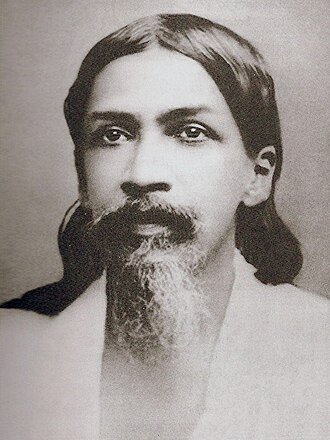
Aurobindo Ghosh
1872–1950 · Indian philosopher, poet and nationalist, founder of Integral Yoga
Childhood and education
Aurobindo Ghosh was born in Calcutta on 15 August 1872 into a Bengali Kayastha family. His father, Krishna Dhun Ghose, had been a member of the Brahmo Samaj and admired British culture, so he sent his sons to England for their education. At the age of seven Aurobindo went with his brothers to Manchester, where the Reverend W. H. Drewett taught them Latin and other subjects. The family later moved to London, where the young Aurobindo entered St Paul's School. He learned Greek and read English literature and poetry with great eagerness, and by the end of the century he knew, according to his biographers, around a dozen languages.
In 1889 he won a scholarship to King's College, Cambridge, where he spent two years preparing for the Indian Civil Service. He passed the written examination with a high placing, but chose not to succeed in the riding test, which barred him from colonial administration. During these years he joined a secret society of young Indians committed to their country's freedom.
Service in Baroda and first political concerns
He returned to India in February 1893, and the Maharaja of Baroda, Sayajirao Gaekwad III, took him into his administration. For roughly fourteen years he worked in several departments, from surveying to the secretariat, and taught French and later English at the state college, where he became vice-principal. Meanwhile he taught himself Sanskrit and Bengali and wrote articles for the press.
His position in the princely service prevented him from taking an open part in politics, so he worked behind the scenes. His writings of this period are sharply critical of British rule, which he accused of relying on force and justifying itself with a claimed moral superiority. After the partition of Bengal in 1905 he left Baroda and threw himself into the nationalist movement. He moved to Calcutta, where he became the first principal of the National College, from which he promoted a national education for Indian youth, and he worked with youth groups such as the Anushilan Samiti.
Activism and the Bengal cause
Aurobindo initially favoured non-cooperation and the boycott of British goods, but he also kept a clandestine network of contacts with Bengali revolutionaries such as Bagha Jatin. In 1906 he attended the Congress meeting presided over by Dadabhai Naoroji, and at the Surat session of 1907 he sided with the extremists alongside Bal Gangadhar Tilak, a move that split the party.
In 1908 he was arrested in connection with the failed attack on Magistrate Kingsford, in which two British women in another carriage were killed. He was held in Alipore jail, mostly in solitary confinement, for a year. The trial, known as the Alipore Bomb Case, ended with his acquittal in May 1909, partly because the chief prosecution witness was murdered inside the prison. The confinement profoundly changed his outlook: he later said that he had heard the voice of Vivekananda in his cell and had experienced a sense of calm that he attributed to a spiritual realisation.
Retreat to Pondicherry
After his release he founded two publications, Karmayogin in English and Dharma in Bengali, but pressure from the colonial authorities continued. Seeking refuge, he went into hiding at Chandannagar and in April 1910 reached Pondicherry, then a French colony, where the British arrest warrant could not be enforced. There he gave up political activity and devoted himself to yoga. In 1914 he started the monthly philosophical review Arya, which appeared until 1921 and carried most of his major essays.
In Pondicherry he also formed a decisive partnership with Mirra Alfassa, born in Paris, whom disciples called the Mother. She arrived in the town in 1914 and settled there permanently in 1920. As the number of disciples grew, the Sri Aurobindo Ashram was formally established in 1926. After he withdrew from public life in November of that year, it was the Mother who organised and directed the community, and she carried on his work after his death.
Philosophical work: integral yoga
The core of his thought is Integral Yoga, also called supramental yoga or purna yoga. Against a tradition that sought liberation from the world and the negation of matter, Aurobindo proposed that the aim of spiritual practice is to transform earthly life. He held that Brahman manifests in reality through a divine play, and that evolution is neither an error nor an illusion but a process leading progressively to higher forms of consciousness. He set out this evolutionary horizon in his major work The Life Divine and in The Synthesis of Yoga.
At the centre of his system is the Supermind, a power intermediate between the unmanifested Absolute and the world. The human mind, in his view, contains this capacity in germ, and the integral transformation of mind, life and body could come about only through the descent of that supramental power. Aurobindo read Heraclitus, Plato, Plotinus, Nietzsche and Bergson with care, and later readers have noted parallels with Hegel and Teilhard de Chardin. Yet he insisted that his thought had grown out of direct experience of the Upanishads and the Bhagavad Gita rather than out of the ideas of other philosophers.
Poetry and writings
Although he is chiefly known as a philosopher, his poetic output was substantial. His most ambitious work is Savitri: a Legend and a Symbol, an epic poem in blank verse of about 24,000 lines that takes a brief episode from the Mahabharata and turns it into a description of his own inner experience. He worked on it and revised it through the last decades of his life. He also wrote commentaries on the Vedas, the Upanishads and the Gita, essays in literary, social, political and historical criticism, devotional works, and an extensive correspondence with disciples, collected in several volumes of Letters on Yoga.
Final years and legacy
During the Second World War he openly supported the Allies, convinced that Nazism posed a threat to humanity's future. After Indian independence in 1947 he opposed the partition of the country, and he declined the presidency of the Indian National Congress. He was nominated for the Nobel Prize in Literature in 1943 and for the Nobel Peace Prize in 1950. He died in Pondicherry on 5 December 1950, aged 78, and tens of thousands of people attended his funeral.
His influence has spread across several fields. In India, Subhas Chandra Bose cited his example in deciding to devote himself full time to the national movement. In the West, writers such as Mircea Eliade, René Guénon and Ken Wilber regarded him as a representative of the Indian spiritual tradition, although Guénon criticised some works published under his name. Karlheinz Stockhausen drew on his writings during a period of personal crisis, and Jean Gebser cited him in several of his works. Today the Ashram and Auroville, the international city founded near Pondicherry in 1968, are the principal heirs of his project.
Key ideas
- The psychic being: the divine dwells in each person as an inner presence that can guide outer life.
- The Supermind: an active principle of the divine able to transform consciousness and lead it from ignorance toward greater light.
- Integral Yoga: spiritual practice should not withdraw from the world but transform body, mind and matter.
- Evolution: human history moves toward a higher unity in which consciousness becomes ever fuller.
Works in Filopedia
Curiosities
Nobel nomination
His work The Life Divine earned him a nomination for the Nobel Prize in Literature in 1943, the year the award was not given.
A deliberately failed exam
He went to the horse-riding examination of the Indian Civil Service without any real interest and made sure to be disqualified, giving up a career in the colonial administration.
A false report
His father was waiting for him to arrive from England, but was wrongly told that the ship carrying his son had sunk off Portugal, and died upon hearing the news.
Teachers and influences
Influenced by
- Henri Bergson 1859–1941
- John Dewey 1859–1952
Influenced
- Ken Wilber b. 1949
- Hugo Bergmann 1883–1975
Original Filopedia text based on Wikipedia (es) and Wikipedia (en) and Wikidata.