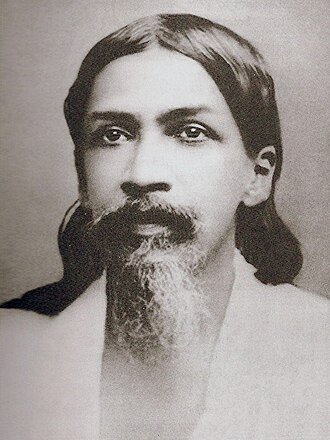
 AuthorAurobindo Ghosh1872–1950
Savitri: A Legend and a Symbol is an extensive epic poem in English by the Indian thinker and poet Sri Aurobindo (1872-1950). It runs to nearly 24,000 lines, divided into three parts, twelve books and an epilogue, with 49 cantos in all. Its narrative basis is a brief episode from the Mahabharata, the story of Satyavan and Savitri, which in the ancient tradition tells of the marital fidelity of a woman who confronts the god of death to restore her husband to life.
Sri Aurobindo began working on the story around 1916 as a narrative, but around 1930 he transformed it into an epic of wider scope and deeper meaning. It became his major literary work, and he continued to expand and perfect it until his last days. Some cantos appeared in print in 1946, the first part of the first edition was published in 1950, and the remaining parts followed the next year, after the author's death. His disciple and secretary Nirodbaran described the long process of composition, with its many versions and revisions.
The poem reinterprets the myth as a spiritual allegory. The first part centres on the yoga of King Aswapati, Savitri's father; the second on the protagonist's own experiences; and the third on her struggle with Yama, the god of death. Sri Aurobindo thus presents the liberation of humanity from ignorance, unconsciousness and death through a divine grace descending upon the Earth, and he describes the ascent through successive planes of consciousness, from the subtle physical world up to the supermind. The author regarded it as a symbolic epic of supramental yoga.
The verse is a regular blank verse of iambic pentameters, a form Sri Aurobindo took from Milton but subjected to greater regularity, creating a rhythm he called mantric. Its reception has been mainly within the circles of the Pondicherry ashram and the community of Auroville, where commentaries and critical editions have appeared. Beyond that milieu its circulation remains limited, but it is recognised as one of the major epic poems written in English in the twentieth century.
Themes
Original Filopedia text based on Wikipedia (es) and Wikipedia (en) and Wikidata.